Homeschool Discoveries

Sharing a few things I've discovered along the way…

Book Discoveries This Week: Cheaper by the Dozen January 31, 2013

Filed under: Books — kirstenjoyhill @ 5:45 am
Tags:

When I select our chapter book read-alouds for the year, I typically reference several different lists of literature to find some of the best titles recommended for a particular age group.  I’ve very rarely found myself in the position of feeling like I had made a potentially questionable choice as far as the appropriateness of a book for my kids.

I picked up a copy of Cheaper by the Dozen by Frank B. Gilbreth and Ernestine Gilbreth cheaper by the dozenCarey at one of the many book sales I’ve attended in recent years — I think I vaguely recalled having seen it on one of my book lists…then seeing it on my shelf when I was making my list to read-aloud to Miss M, I added it since we already had a copy.

Overall, I guess it was an okay choice to read — Miss M thought it was really funny (as did I).  But if I would have known a bit more about the content of the book, I think I would have saved it for when Miss M was just a bit older.

Cheaper by the Dozen is a biographical tale about the family of famous efficiency experts Frank and Lillian Gilbreth.   Mr. Gilbreth has many useful ideas for improving efficiency in factories and other workplaces, and he tries to incorporate some of those ideas at home…with predictably funny results.  Of course, life in general with a family of 12 kids is bound to be funny!  The book takes place in the early 20th century, and some of the antics of the Gilbreth family seem especially funny now, considering “modern” sensibilities — like tonsils removed assembly line style at home, and the whole troop of children piled seemingly one on top of another in the back of the family car with two crying babies on mom’s lap.

The chapters of the book are somewhat thematic, while there is also a bit of time progression as the book continues on — stories of first dates and learning to drive are found more toward the end of the book.

Speaking of those first dates…this gets into a few things I found “questionable” about the content of this book — at least when considering at as read aloud for an 8.5 year old.   As the girls of the family get to be teenagers, there is discussion about what they might be doing with their boyfriends.  Nothing graphic of course…but I really don’t need to be explaining “necking and petting” to my 3rd grader.

There’s also a “peeping Tom” who wants to watch one of the girls through the window as she puts on her pajamas, and a lady on a birth control crusade who is sent to the Gilbreth home as a joke by a friend who has a large brood of children herself.  Not awful topics to be discussing with my daughter…but definitely different than the topics our read-alouds usually bring up.

Members of the family take the Lord’s name in vain regularly — luckily this is pretty easy to edit out, though I forgot a few times and saw a pretty surprised look on Miss M’s face (since that’s not something that would be acceptable in our home)!

After we finished the book I started to wonder whether I imagined ever having seen Cheaper by the Dozen on a list of recommended reading for elementary age students.  A little bit of research revealed that this title used to be included on Sonlight’s Core E list (for approximately 4th grade), but was discontinued from their curriculum.   Too many complaints about the content, perhaps?!?

And, in case you were wondering, it seems like the more recent Steve Martin movie of the same title bears little resemblance to the classic book.  A film of the same title made in the 1950s is apparently more faithful to the original — I have have a DVD of that movie waiting for me on the reserve shelf at the library.  🙂 I’m assuming a 1950s movie will be pretty family friendly for a movie night this weekend (but I probably should research that a bit more just to be sure!)

I’m linking up with Read-Aloud Thursday @ Hope is the Word!


Maple Syrup Snow Candy January 29, 2013

Filed under: Books,Fun Stuff and Extras,History — kirstenjoyhill @ 6:06 am
Tags:

This is an activity that has literally been years in the making for our family.  🙂 I’m not sure if it was after I first read “Little House in the Big Woods” out loud to Miss M or if it was on a later re-reading, but we found this passage inspiring:

“They all hurried to the kitchen for plates, and outdoors to fill the plates with snow…Grandma stood by the brass kettle and with the big wooden spoon she poured hot syrup on each plate of snow.  It cooled into soft candy, and as fast as it cooled, they ate it.  They could eat all they wanted, for maple sugar never hurt anybody.”

Two winters ago, we had plenty of snow.  Miss M asked me several times if we could buy real maple syrup to make the maple sugar candy.  I never quite got around to buying the maple syrup.  Then last winter we had very little snow, and not much at any one time when we did get any.

For months before this winter, the kids were asking, “Mom, is THIS the year we’ll make the maple syrup snow candy?” I resolved to finally make it happen.   I found real Maple Syrup at Aldi after our first snow of the year had mostly melted (yea for bargains!), and then we just had to wait for another significant snowfall.  It’s been a dry winter, but we finally got a few inches of snow on Sunday.

After reading a recipe or two, as well as the comments about those recipes…I decided that maybe it didn’t really matter exactly how I made this maple syrup snow treat.  Microwave the syrup? Use room temperature syrup?  Random people on the internet made me think this easy solution would work just as well as the complicated idea of boiling the syrup on the stove to a certain temperature.  Here’s what it looked like on our first effort:


Maple snow candy take 1

The result was more like…maple-flavored snow cones? Or maybe a bit like a maple “ice cream” of sorts?

I didn’t want our memory of this activity to be so un-candy-like, so I thought we could try again the next day. After a bit more reading, I decided maybe the recipes were right — We needed the syrup heated up to a higher temperature for the syrup to turn into candy.  I don’t own a candy thermometer, so I had to rely on the cold water test to determine if my syrup was hot enough.

Here’s take two:

Maple syrup snow candy 2

Our result was much better, but still overcooked.  I under estimated the time it would take Miss M to retrieve a pan of snow from outside.  Meanwhile, my syrup got hotter and hotter — almost to the point of burning.  It was probably at stage 5, the hard crack stage, instead of stage 1 the soft ball stage!   But luckily, hotter produces candy of some variety!

Our candy was not taffy-like at all, but hard and brittle…yet still tasty (if a bit burnt tasting!). I also realized as I was making this that using a sheet of ice would produce pretty much the same result.  Of course, in the pioneer days of Little House in the Big Woods, no such sheets of ice were conveniently available in the kitchen.    But in this modern day and age, if it is just the maple candy taffy “result” we are looking for, there’s no need to wait for a snow day! 🙂

There is a lot of potentially interesting science study involving the science of sugar and candy-making.  I found this unit study on candy to be very interesting! I didn’t spend a lot of time looking, but I’m sure there are many more candy science resources to be found.

I may try the maple syrup candy yet again with a candy thermometer, just to say I’ve mastered this generations-old treat…or maybe we’ll move on to making the best-possible rock candy.  That’s what the kids are voting for!


“The Year of the Horseless Carriage 1801” by Genevieve Foster January 28, 2013

Filed under: Books,History — kirstenjoyhill @ 6:00 am

Inventions and inventors are often a topic of interest for our family, so I was intrigued when I ran across The Year of the Horseless Carriage 1801 by Genevieve Foster.   In this book Foster weaves together a narrative of  early 19th century progress and invention with threads of world history that were occurring at the same time.

The “horseless carriage” in this case is essentially a stem engine on wheels — more of a precursor to the locomotive than the automobile (the device more commonly referred to as a horseless carriage).  Richard Trevithick is an English engineer with plenty of ideas about how to use the steam engine to make a useful vehicle.  He may have been a little ahead of his time,  but his ideas paved the way for more modern locomotives.  At about the same time American inventor Robert Fulton wondered what would happen if he put a steam engine in a boat, and had a bit more long term success from his endeavors.

While telling the stories of Trevithick, Fulton and others that collaborated with them, Foster also tells the stories of a few major socio-political events of the first two decades of the 19th century — including Napoleon, Lewis and Clark and the War of 1812. She also weaves Beethoven into her story — I hadn’t exactly realized he was contemporary to this time period.  An interesting note here is that apparently Beethoven greatly admired Napoleon at one point and originally dedicated his 3rd symphony to him — but rescinded the dedication after it became apparent that Napoleon was turning into a cruel tyrant.

I read this book aloud to Miss M and Mr. E.  They enjoyed it enough to typically ask me for more after I read a few pages.  🙂  Some of the material in this book was repetitive for us since we were also reading A New Nation by Betsy Maestro at the same time.  I skipped a few pages and paragraphs here and there to make sure the kids didn’t get too bored with the repetition.

Overall, we all enjoyed Foster’s very engaging narrative style.  She is really telling a story with history.  Because we were reading other books about the same time period as well, I might have enjoyed a book just about the inventors and inventions written in the same style a bit more — but especially for anyone looking for just a brief introduction to this time period (1801 to 1821), this book is a good choice. At only 92 pages (which include quite a few nice black and white illustrations drawn by the author), it didn’t really take us too many sittings to read this book.

I’ve checked out a few other of Foster’s books from our library, but those were a bit longer both in page length and amount of time covered — I’ll be keeping those in mind for the future when the kids are a bit older.


Book Discoveries this Week: Three Stories about Being Alone in the Wilderness January 23, 2013

Filed under: Books — kirstenjoyhill @ 11:06 pm

With my recent holiday blogging break, I’m a bit behind on sharing about our read alouds!  We took a read-aloud break in late December and early January as well (between travel and sickness, regular reading time was hard to come by!), but we finished three read-alouds in recent weeks that I realized all had a common theme.

Our selection of books about being alone in the wilderness began naya nukiwith Naya Nuki: Shoshoni Girl Who Ran by Kenneth Thomasma.  We enjoyed another book by Thomasma earlier this fall, and I had originally planned for this book during our initial US History unit on Native Americans.  However, once I had this book in hand I realized it fit much better in the unit we just finished on America as a new nation after the Revolutionary War.

Naya Nuki and several other members of her Shoshoni tribe are captured and taken prisoner by an enemy tribe.  She and her fellow captives are forced to walk for days to this tribe’s village, where they become slaves.  Naya Nuki’s closest friend and fellow captive is none other than Sacajawea — who of course later becomes famous as a guide to explorers Lewis and Clark.

Naya Nuki sets her mind on a different path than that of Sacajawea or any of her other fellow captives.   She is bound and determined to escape and return home — no matter what dangers she might face on the way.  While on the outside she looks like a model servant, she secretly plans her escape and hides away supplies she will need.

When the moment is right, Naya Nuki runs under cover of darkness from her captors — and thus begins a journey of many weeks to trek many hundreds of miles to the home of her people.   Naya Nuki is a very brave young woman, and she is incredibly resourceful as she perseveres through the long journey across prairie and mountains to her homeland.

Miss M and I both enjoyed this exciting story.  I’m bummed that our library doesn’t have any of Thomasma’s books.  I guess I shouldn’t complain too much since our library usually has just about everything I am looking for.  😉  But used copies are available very inexpensively on amazon of many of the books in his Amazing Indian Children series.

Next Miss M and I read Sarah Witcher’s Story by Elizabeth Yates.  I originally had this book planned for Miss M as an independent reading selection for history.  As this book was nearing its library due date (with no option to renew — somehow our library system only has one copy and someone else wanted it too), I decided the surest way to make sure we read it before it went back was to make it our next read-aloud.

This was a pretty quick read for us.  Sarah Witcher is a young girl from a  family in New Hampshire in the early 19th century.   She’s very young — her age is never given, but I am guessing she must have been three or four.   While her parents go off to visit friends and leave Sarah’s older siblings in charge, Sarah wanders away to play in the woods.   Her siblings are absorbed in what they are doing, and see so little of Sarah they assume their parents must have taken Sarah with them!  Sarah’s disappearance is realized at the end of the day, touching off a multi-day search in the nearby woods.

Sarah, meanwhile, is surprisingly resourceful for a young girl.  I don’t want to give away too much of the story, but a great deal of her survival is thanks in part to a wild animal she mistakes for  (or perhaps just really wants to believe is) the family dog.

As you might guess, this story has a happy ending and shows a great portrayal of her family’s unwavering faith that God cares for them.

Our final read-aloud fitting in with this theme is a bit different, since it deals with an even shorter time period of being out there alone.  The Bears on Hemlock Mountain by Alice Dalgliesh is an easy-reader chapter book I selected as a read-aloud for all the kids.  We pretty easily finished it in one long sitting, so even a newer reader who is ready for this sort of reading could probably finish it in short order.

Jonathan is asked by his mother to complete an important errand — going over Hemlock mountain to his Aunt’s house, and returning with a large pot needed for an impending family gathering.  Hemlock mountain is called a mountain, but we’re told it’s really just a big hill.   Jonathan fears there might be bears on Hemlock Mountain…but, no, that’s not really true, is it?  After Jonathan lingers just a bit too long at his Aunt’s house, he finds out for himself the truth about the bears on Hemlock Mountain.

For as “easy” of a read as this book it, it really makes a great read aloud.  There is the rhythmic refrain of , “There are no bears on Hemlock Mountain. No Bears! No bears at all!…”, to the other opportunities for dramatic pauses while reading that make this book a fun one to share out loud.  All three older kids (ages 8, 5, and almost 4) like this one a lot and begged for me to read “just a little more” until the whole book was finished!

I’m linking up with Read-Aloud Thursday at Hope is the Word!


Book Discoveries this Week: Carry on, Mr. Bowditch January 16, 2013

Filed under: Books — kirstenjoyhill @ 7:00 am

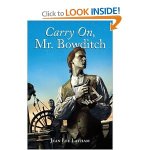
bowditchI honestly wasn’t sure if Miss M and I would enjoy, Carry on Mr. Bowditch by Jean Lee Latham when I added it to our United States History Year 1 reading list for this year.   But given that it’s a Newberry award winner (1956), and it is a recommended choice from Sonlight’s list of American history titles, I decided to go ahead and give it a try — I’m glad we did!

Carry on Mr. Bowditch is a fictionalized biography of a real person, Nathanael Bowditch, who lived from 1773 to 1838.   The story opens with Nat Bowditch as a precocious young boy who shocks his school teacher with all the math he has learned to do all by himself.  He dreams of a bright future for himself as a “Harvard man” when he is old enough for college.   But instead of preparing for college, his family’s financial situation forces him to leave school and work in his father’s business. Then at age 12, he is indentured for a nine year term to a chandlery (a store that sells all the items needed for ships).

He took every opportunity to continue his education on his own during those nine years, and he is soon a master of several languages, science and mathematical concepts and all things nautical.   After his term in the chandlrey is completed, Nat Bowditch takes to the sea, where he develops better methods of navigation and eventually writes a book for which he is still famous — The American Practical Navigator.

Miss M appreciated the adventure aspect of this story.  Nat Bowditch’s travels on shipboard take him all over the world and Miss M was eager each night to find out how these adventures would work themselves out.    I found the details in Carry on Mr. Bowditch to be fascinating.  I always enjoy learning about a new subject, and nautical navigation was certainly a new subject for me!

As I was reading this book to Miss M I ran across a number of great quotes I thought I might include in a review of this book…but unfortunately holiday busyness got in the way of writing this post in a timely manner (we finished this book mid-December!), and I had to return my copy to the library.   It’s definitely a title I’ll be remembering to read to the boys when they get a bit older.  Nathanael Bowditch is a great example of a man who worked hard to make something of himself despite the obstacles in his path.

I’ll be linking up with Read Aloud Thursday @ Hope is the Word!


Book Discoveries this Week: Black Beauty and Justin Morgan Had a Horse December 6, 2012

Filed under: Books — kirstenjoyhill @ 10:27 pm
Tags:

Miss M and I have been on a bit of a “horse kick” the past few weeks with two horse-related read-alouds:  Black Beauty by Anna Sewell and Justin Morgan Had a Horse by Marguerite Henry.

We did a horse unit study last Spring, so this is not a new interest on Miss M’s part.  But of course there are so many great horse-themed books out there it may take awhile to get to all of them.  😉  Black Beauty was a read-aloud I considered last year.  But somehow I had gotten the impression it was a really sad (or even depressing) book, so I didn’t end up selecting it.   So far this school year, my bed time read alouds with Miss M have all been history related, mostly due to her desire to keep selecting historical titles tied into our American History studies.

After our last read-aloud, Miss M asked that we picked something unrelated to American history next.  After a brief attempt at a fantasy book that neither of us were very keen on, we decided to go for historical fiction of a different sort than we have been reading.  I chose Black Beauty from my list of potential non-US-history read-alouds for the year.

In case you aren’t familiar with the plot of this classic story, Black Beauty is told from the perspective of a horse in 19th century England.  Black Beauty gets his start in life as a colt on farm where he trained and treated kindly, after which he is sold to a gentleman named Squire Gordon.  The Squire and his employees also treat Black Beauty very well, but when the Squires wife falls ill, the horses all must be sold.  Thus begins a long line of owners for Black Beauty ranging from another nobleman to cab owners to a corn dealer.

Sometimes Black Beauty is treated well, other times he is ill used or treated harshly.  But in all cases he maintains what you might call “good character.”  He remembers what he was taught in his youth, and always does his best to work hard and not return evil-for-evil.  There are some difficult moments in Black Beauty, which may be where it got its reputation for being a sad book in some ways.     Animal cruelty is definitely present in this book, and a few horses (other than the main character) do die through the course of the story.   But moral lessons are present throughout and I think the author’s hope was that by telling this story of how horses were treated, that perhaps people might think twice about how they treat their horses or other animals.

Miss M and I both definitely enjoyed this book — she told me it may be her favorite read-aloud so far of the 2012-2013 school year!

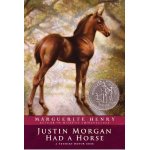
We continued with the horse theme but also picked up with our current historical time period in US History (roughly the time from the end of the Revolutionary War through the War of 1812) with Justin Morgan Had a Horse.  This 1946 Newberry Honor book begins shortly after the Revolutionary War, and ends sometime after the War of 1812.   It’s a fictionalized account of the horse that was the foundation sire for the Morgan Horse breed, one of the first breeds to be developed in the United States.

Henry’s story opens with schoolmaster Justin Morgan and his young pupil Joel taking a justin morganlong journey from Vermont to Massachusetts to visit a man who owes money to Mr. Morgan.  Morgan’s friend can’t pay back the loan in cash, but offers two horses instead.  Little Bub was so little that Morgan hardly wants him at first.  Joel, on the other hand, just knows that Little Bub would grow up to be a special horse.

Time proves Joel to be correct.  Justin Morgan gives Joel the opportunity to gentle this special horse.   Little Bub may be tiny, but he can pull and race better than the best of them.   Joel hopes to some day buy Little Bub for himself – but the road to owning the horse he loves turns out to be much longer than he expected.

Justin Morgan Had a Horse is the story of a famous horse, but it’s also a coming-of-age story as Joel grows into manhood, and never gives up his dream of bringing Little Bub home to his own stable.

This was another book that both Miss M and I really enjoyed.  It was a quick read — one that Miss M could have easily accomplished on her own.  But I’m glad we shared it together, as I am putting it at or near the top of my list of favorite read-alouds for this school year!

I’m linking up with Read-Aloud Thursday at Hope is the Word!


Book Discoveries this Week: “This Plus That” and other picture books November 29, 2012

Filed under: Books — kirstenjoyhill @ 10:31 pm

I looked back in the archives, and I discovered I haven’t written a general picture book post since July.  I’ve tried to write little notes to myself here and there about books we’ve enjoyed, but in the course of nearly five months I’m sure I’ve lost a few of those notes.   Several years ago, before the Minneapolis city library system merged with the county library system, the catalog had a “history” function that listed all the books you had ever checked out.  Oh, how I miss that.  (Everything else about the larger merged library system is great, though!)

Far and away, everyone’s favorite picture book from the couple months has been This Plus That: Life’s Little Equations by Amy Krause Rosenthal, illustrated by Jen Corace.   It’s a really clever book that sums up life in some very insightful ways:

Tall + Coffee = Grown-up

small + Bottle = Baby

Somersaults + Somersaults + Somersaults = Dizzy

Cozy + smell of pancakes – alarm clock = weekend.

Everyone found an “equation” to love, and a couple months after we first checked it out (it’s one we keep renewing, and renewing since no one wants to bring it back), we’re still quoting it and coming up with our own “equations.”  We even considered modeling our Christmas card/letter after this book (DH’s idea of a “corporate report” style letter with charts and graphs he has been working on while laid up with his leg injury won out for this year…but I’m saving this idea for a future year!).   I think this is one I might need to buy a copy of for our collection.  🙂

Here are a few “quick takes” on other picture books from the library we’ve especially enjoyed in the last few months:

Chicken Big: Chicken Big towers over the coop and everything else in the barn yard.  But if it’s something THAT big, could it really be a chicken? The other chickens in the barnyard aren’t so sure.  But size does have its advantages, as Chicken Big is able to prove.

39 Apartments of Ludwig Van Beethoven: I’ve seen/heard of this book for quite a while, but one of the kids grabbed it off the shelf on a recent library trip.  It was funny enough to the boys that they requested multiple readings of this book about how much work it might have been for Beethoven to move his five pianos to various apartments in his lifetime.

What to Expect When You Are Expecting Joeys: We read several non-fiction picture book titles about Australian animals recently, but this one was my favorite.  Written as though it were a guidebook for a marsupial parent-to-be, it packs in a lot of information about not just well-known marsupials like the kangaroo and koala, but many lesser-known marsupials as well.  I just discovered there is another about expecting larvae in the same series.  I’ll think the boys would enjoy that one too!

Al Pha’s Bet:  Al makes a bet with himself…that maybe he can find a great way to put 26 letters order.  I bet you can guess what Al’s last name is? 😉 This was a silly but fun alphabet book to share with Mr. K.

Do Not Build a Frankenstein:  A boy has some advice — building your very own Frankenstein may sound like a good idea…but take his word for it.  It’s not! Very funny!

Take Your Mama to Work Today:  Violet visits her mother’s office and has one viewpoint on all the ways that she is helpful to her mama.   But pay attention to the illustrations for another view on things.  😉  Miss M and I enjoyed this one together (I like that she still humors me and lets me read her a picture book every now and then!).

I’m linking up with Read Aloud Thursday @ Hope is the Word!


Book Discoveries this Week: “Sophia’s War” and “Ben and Me” November 15, 2012

Filed under: Books — kirstenjoyhill @ 10:58 pm

As we continue working our way through our stack of books on the Revolutionary War, we’ve finished two more chapter books from that time period — Sophia’s War by Avi and Ben and Me by Robert Lawson.

I read Sophia’s War as a bedtime read-aloud to Miss M.   It’s definitely more of a middle-grade read — even last year I think Miss M (currently age 8) would have been too young for it.

Twelve-year-old Sophia Calderwood lives with her parents in British-occupied New York City in 1776.  She and her family are patriots, though they keep this fact well-hidden in order to secure their safety.  Her older brother had earlier joined the Continental army, and initially Sophia and her parents do not know his fate.  Unfortunately, Sophia learns that her brother has been captured and thrown in a British jail.  Conditions in the British jails are  horrendous, and, despite Sophia’s best efforts to prevent it, her brother dies in captivity.

Soon after this event in the story, the narrative jumps ahead to 1780.  Now 15, Sophia is providing for her family by working in a print shop.  She meets a mysterious gentleman who gives her an unusual opportunity — Sophia becomes a housemaid in the British military headquarters in New York, with the intention of reporting information to the Americans.  She uncovers a plot so unbelievable (involving Benedict Arnold), she will have to go to extreme lengths to stop the treason.

Miss M and both really enjoyed this book, the first we have read by Avi.  The short chapters keep the action moving quickly (and easily entice me into reading one more chapter.  And then another, and another…).  It’s the type of book that had I been reading it to myself, I might have stayed up very late to finish.  🙂

It’s obvious that this book is very well researched — I love how Avi wove Sophia’s story into the true story of Benedict Arnold’s attempt to give West Point to the British.  This is definitely not a story for a very sensitive child — Avi doesn’t hesitate to describe things like a hanging and the awful conditions in which the British held American prisoners.   Overall, I’m very glad I added this one to my list of read-alouds for the Revolutionary War!

In contrast to Sophia’s War, Ben and Me by Robert Lawson is one of those historical fiction books that barely qualifies for the label  “historical”.   I read this to all the kids, mostly as an “afternoon snack time” read-aloud.  Ben and Me is written from the perspective of a pet mouse, Amos, who is supposed to have lived in Ben Franklin’s hat.

Throughout the story we get the “real” perspective on events in Ben’s life.  It was Amos who provides the ideas to invent the Franklin stove, who assists with electricity and lightning experiments and who runs from dignitary to dignitary to listen in and tell Ben what is really going on.

This was a light, funny read-aloud that the boys could easily follow along with.   I’m not sure there was as much “educational value” here as many of the history-related fiction books we’ve read, but it was fun nonetheless.

I’m linking up with Read-Aloud Thursday at Hope is the Word!


Book Discoveries this Week: Three Revolutionary War Titles November 1, 2012

Filed under: Books,History — kirstenjoyhill @ 3:10 pm
Tags: ,

In our US History studies this year we’ve hit the Revolutionary War period, and we’ve already completed a few read-alouds related to this theme.

I hadn’t necessarily intended for all my bedtime read-alouds with Miss M to be focused around our history themes, but so far that has been the case.  After finishing The Witch of Blackbird Pond, I thought we would go for non-history read aloud.  We read one chapter of The Wind in the Willows, and neither of us really liked it.  I know it’s a classic, but I wasn’t impressed after that short trial.  I checked out a “Classic Starts” abridged version, and I may assign that to Miss M at some point in the near future.

I needed a new read-aloud more quickly than I expected, but I didn’t have some of the other history-related titles for Miss M handy (and she requested another history read-aloud).  So, I looked at All Through the Ages to see if I could find something that I could acquire as a free ebook.  A Little Maid of Old Philadelphia by Alice Turner Curtiss seemed to fit the bill, so I downloaded it from Amazon.

A Little Maid of Old Philadelphia takes place in British-occupied Philadelphia in 1778.  Ten year old Ruth Pennell is the “little maid” of this book (there are several other “Little Maid” titles by the same author featuring different girls in different cities).  As the story opens, Ruth’s aunt is staying with her while her mother is away caring for an ill relative and her Father is with General Washington’s army — and Ruth’s dog is missing.  Ruth takes matters into her own hands to find the dog (and meets an important figure in the British army in the process!).  She has a series of other adventures along with a few of her friends that culminate in her very own opportunity to help the Patriots in the war effort.

Miss M and I generally both like these kind of  “episodic” stories about young girls and their adventures, and this was no exception.  I think I can see, though, why this one maybe didn’t survive the test of time to become a well-known classic.  Compared to more modern works (or even more “classic” older books), the tone of A Little Maid of Old Philadelphia was a bit moralistic at times.  Ruth got herself into a bit of trouble with some of her adventures, and the author was not particularly subtle about what lesson Ruth (and the readers of the story) was supposed to learn about asking permission to do things, borrowing things that belong to others or letting a grown-up know where you are going!

These obvious moral lessons didn’t seem to bother Miss M at all — she was very eager to read other titles in this series (at least four of which were available free in Kindle format at amazon.com — I haven’t looked around to see if any of the other titles in the series are available as free ebooks).

After A Little Maid of Old Philadelphia, we moved on to Toliver’s Secret by Esther Wood Brady.   Ellen Toliver is another 10 year old girl, this time living in New York City (also occupied by the British).  Though I didn’t catch a date in this story, from the events described I would guess it perhaps takes place in 1777.     Ellen is shocked to learn that her Grandfather is a spy for the patriots.   When Grandfather is injured and can’t take a secret message across the river, he asks Ellen to take his place.   It was supposed to be a simple mission of riding across the river with the merchants and finding Grandfather’s friend at a tavern.  Nothing goes according to plan, however, and typically-timid Ellen is faced with a very difficult and dangerous journey.

This was a quick and exciting read for Miss M and I.  She could have easily read it on her own (and did read a couple chapters out-loud one night while I put away my laundry!), I enjoyed sharing it together with her.

After finishing this book we started another Revolutionary spy tale – Sophia’s War by Avi.  This is a bit more mature and complex story.  We’re only a few chapters into it, and I’m eager to find out how this book will develop.

Finally, I have a picture book read aloud to share:  Those Rebels, John & Tom, by Barbara Kerley, Illustrated by Edwin Fotheringham.   Thanks to Amy @ Hope is the Word for the recommendation of this title! We have quite a few picture books from this era in our book basket, but Miss M has been reading most of them independently, and the boys haven’t been picking them on their own.  Finally this week I asked Mr. E to pick a book from the history book basket as a part of his school time, and Mr K and Miss M decided to listen as well.  Those Rebels, John and Tom is a biography of two famously different friends — Thomas Jefferson and John Adams who put aside their differences for the good of a new nation.   I loved Kerley’s writing style — it’s pretty lighthearted for a serious topic, which makes it all the more fun for everyone listening to the book.     The illustrations are a bit in the style of political cartoons, and the kids enjoyed looking for some of the details in the pictures.

We’re knee deep in Revolutionary War books around here, so I’m sure I’ll have more to share in future weeks!

I’m linking up with Read-Aloud Thursday @ Hope is the Word!


Book Discoveries this Week: Sign of the Beaver and The Matchlock Gun October 26, 2012

Filed under: Books,History — kirstenjoyhill @ 9:01 am
Tags:

For the past couple of years, most of our longer read-alouds have happened at bedtime, with just me and Miss M.  Tony reads picture books to the boys while I try and read a chapter or two to Miss M of our current book.  This year, I’m trying to incorporate Mr. E into a few more chapter book read-alouds.  What seems to be working so far is to start reading to the kids during a meal or snack.  If the book is engaging enough, Mr. E and Miss M will both be more than happy to keep listening even after the food is gone.  Mr. K will usually wander away…but he is only three and a half, so I don’t really expect a huge degree of interest in books with few pictures.  🙂

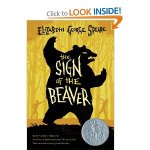
When I first started reading The Sign of the Beaver by Elizabeth George Speare, both Miss M and Mr. E begged for chapter after chapter of reading in the very fist sitting.  Our pace slowed down after that, but both of them really enjoyed this book.

In The Sign of the Beaver, 13 year old Matt and his father have traveled to Maine to get land and build a cabin in the late 1700’s.  With the cabin built, Matt’s father leaves to retrieve the rest of their family while Matt stays behind to guard the cabin.  While alone in the wilderness, Matt faces challenging circumstances — and also finds an unlikely friendship with an Indian boy named Attean.

Unlike many historical fiction novels set in early American history, this book portrays a really positive relationship between Native Americans and settlers — even if it is just one young settler in this story.  Attean has things to learn from Matt as Matt tries to teach him to read English.  But Matt seems to learn far more as he learns from Attean how to survive in the wilderness with limited supplies.

This might be my favorite read-aloud so far of this school year.  I think the kids might agree — it was one of those kind of books that make you a bit sad at the end that the story is already over.

I made a conscious decision to read The Sign of the Beaver to the kids before reading them The Matchlock Gun by Walter Edmonds. These two books take place in the same general time frame, but The Matchlock Gun is set in a time and place of armed conflict between settlers and Indians.  This short chapter book (or you could possibly call it a long picture book), tells the story of the Van Alstyne family near Albany, New York around 1757.  As Teunis Van Alstyne leaves to do his duty with the village militia, Edward and his mother and sister are left behind on the family farm to defend it against the possibility of attacking Indians.  What seems like a remote possibility at first becomes more and more real as the story progresses, to the point where Edward must truly use his Grandfather’s Matchlock gun than even his father has never fired.

The boys in particular seemed to enjoy the suspense and excitement of this story (Mr K even listened, thanks in part to lots of pictures and a bowl of popcorn!), while Miss M thought it was just “okay”.

This Newberry Award winner published in 1941 is not without controversy.  Many reviewers on Amazon labeled this book as racist — and I have to admit, I can kind of see why.  The illustrations are kind of “cartoonish” in a way — playing on the fears of what scared settlers probably saw in their minds’ eye as they imagined the possibility of being attacked by local Indians.  There is also one paragraph in particular that describes how Gertrude Van Alstyne saw the Indians coming through the woods , and describes them as looking less than human.  I will admit, I skipped this paragraph when reading out loud to the kids.

The Matchlock Gun is based on a true story that was handed down through the Van Alstyne  family.  You can imagine that as a story like this of frightening attack is told time and time again, the tone of the story would be of fear and the heroism of the boy who defended his family — not of the potential grievances the Native Americans had against the settlers, or of other nuances of the French and Indian wars.   So given that perspective, and the age of the book, I feel like I can forgive its potential offenses.   But, this is why I read this book to the kids after Sign of the Beaver — so we could discuss how different each boy’s experience was with the Native Americans and why.

I’m linking up with Read Aloud Thursday @ Hope is the Word!