Homeschool Discoveries

Sharing a few things I've discovered along the way…

American History Unit 1 Recap: Native Americans/Explorers October 16, 2012

Filed under: Books,History — kirstenjoyhill @ 11:03 pm

Despite the best of intentions to keep track on a weekly or bi-weekly basis of our American History reading and activities, we’ve now finished two “units” or topics of our self-designed American History studies without a post detailing what we did.

I’ll share a few thoughts here about our first unit (as much for my own benefit as for anyone else’s — so I can remember what I might want to change as we come back around to American History in a few years!), and you can also refer to my general overview page of our US History studies for the year.  I’ll be following up soon with a post about our second unit about the early settlers/colonies.

My goal with our first topic — Native Americans and Explorers — was to expose the kids to some information about what was going on here in North America before Europeans came to stay.  We had read about some of the early European explorers of South American and Mexico last year in Mystery of History Vol. 3,  but I purposely skipped over Christopher Columbus and the early North American explorers to save them for our US History studies.

Next time around, I think I might do things a little bit differently.  I think I would incorporate the explorers into world history of that period (with MOH III or another resource), and spend less time at that point on the American Indians.

When I planned the schedule for this year I didn’t realize, first of all, how many of the resources available regarding various Native American tribes are full of information about how these people groups lived after the Europeans arrived.  Secondly, there are many opportunities to read about Native Americans throughout the settlement/colonial period and beyond.

A few resource highlights:

I assigned Miss M to read Pedro’s Journal and Conquista.  She didn’t really enjoy either one of these very much! I also expectd her to read the Kaya American Girl books, but after reading part of the first one, she let me know that she really wasn’t interested.

Miss M also read a number of shorter non-fiction and fiction books from our book basket.  She really likes the “If you live with…” series of books such as “If you lived with the Sioux”, as well various picture books focusing on Native American legends. She didn’t care as much for some of the other informative books I selected from the library on various tribes and explorers.  The boys also occasionally asked for some of the book basket books to be read to them, but not super often during this unit.

We only completed one chapter book read aloud during this unit, and started one more that we elected not to finish.  You can read more about these two books in this post.

My favorite “overview” resource is The American Story series by Betsy and Giulio Maestro. This series of picture books takes American history from the time before European explorers to 1815 over the course of seven books.  We read the first two for this unit.

As far as written work or projects beyond all our reading, the kids did do one project from the Native Americans History Pockets book (which Miss M declared to be “far too easy.”).  There was very little interest from Miss M or Mr. E in completing any other written projects (lapbook pieces, notebooking, other History Pockets).  The kids did do a few crafts from the book “More than Moccasins,”  like these paper tepees.

In our history studies so far I’ve been amazed by my kids lack of interest in doing much of any written/tangible work or projects.  I’m not going to force it or make a big deal — after all, I am pretty confident that my kids already know more about early American history than I did up until this year since due to various moves as a child I never had the “first half” of American history with much of any depth at all (though I had the “second half” of American history twice!).

We completed this unit about a week or two ahead of what I had originally planned.  Given that we also finished up our second unit a few weeks early (i.e. we had read nearly all the books on our list and the kids were getting tired of that time period), I think I may have planned too long for each unit on our schedule!  Miss M told me the other day that she was worried about what would happen if we studied US History “too fast.”  I let her know not to worry — there is still plenty of American history left, and even if we get further in time this year than I originally planned, I can easily find good history or geography related studies to fill our time.  🙂


Resource Discoveries: Spelling City and “I See Sam” Readers October 2, 2012

Filed under: Curriculum,Technology — kirstenjoyhill @ 10:18 pm
Tags: ,

Today I wanted to highlight a couple of free resources that have been very helpful to us recently!

First for Miss M, my steadily-improving-speller:

We’ve used Spelling City off and on for the past couple years.  It’s a great website, and you can add your own spelling lists for your student to practice or play games with their words. But I we are super excited that Spelling City now has a free iPad app as well.  That’s just an easier way to use this resource.   I’ve entered our Logic of English Essentials spelling lists so far, and plan to keep doing this as we go along (search for me under username aragon95 if you are also a LOE user and want to use the lists too!).  Miss M likes playing “Hang Mouse” and doing word searches.  I’ve also used their “spelling test” feature for a painless end-of-lesson assessment.   The app won’t give away the correct answer if she is struggling (something that I have, uh, been known to do in the past).  And it is very patient.  🙂

Then for Mr. E, my new reader:

I think especially for those of us teaching reading primarily via phonics (and using as few “sight words” as possible), it can be challenging to find appropriate easy reader books.  We’ve read a lot of BOB books, we have some Nora Gaydos readers, and I’ve found some books that work okay at the library, but Mr. E still needs lots of practice to develop fluency in this beginning stage, so we need more books! I have more on the way that I’ve requested from the library, but I also stumbled upon the I See Sam readers:

Aren’t the characters cute?  This set of readers was developed in 1972, but because of the type of government funding that was used they entered the public domain in 1977.

There are 52 short books in the set.   If you are teaching reading via phonics, you only have to introduce a few phonograms beyond the basic single-letter phonograms to have them make sense (ee, th, and wh are the three main ones I’ve seen so far, plus letters doubled at the end of single syllable short vowel words — ll, ff, ss). The level of difficulty increases very, very slowly and there aren’t too many words on each page — features I really appreciate!

Scans of the original books are available here.   Another website, readingteacher.com, has re-formatted the books nicely and even created interactive flash animations/readings to go along with about the first half of the books.  We’re using the printable versions from this site.  It is a bit tricky to navigate and you have to create a free account to access the printable books, but I think it was worth it! (Once you create your account, select “levels”, then after you find the level you want, you can click “parents/teachers” to find the printable books for that level…at least that’s how I got there!).

Since Erik does have some reading experience, I started him out at book 18 (a bit of a random choice — easy enough to build fluency but far enough along to not be too boring).  He loves it so far and has read about five books.

The only downside is, of course, if you want your reader to be holding these books in his/her hands while reading, you’ll have to print them out.  I have a laser printer and the black-and-white pages are pretty sparse in terms of ink use.  The formatting of the books does not lend itself to duplexing, so we’ll use a big stack of paper to print these.  But compared to buying new sets of Bob or Nora Gaydos readers, I am pretty sure we are still coming out ahead.  I think it would be possible to read these on an iPad or other tablet/e-reader type of device, but I am not sure Mr. E would like that as much so we haven’t tried that yet.

Some (or maybe most) easy reader books can be a bit lame due to the limited vocabulary.  In one sense these are just as bad if not worse than others I’ve seen in regards to this measure.  But my five year old and his shadow (aka, Mr K, age 3.5) both think they are hilarious, so no worries about lameness from their target audience I guess!

Have you found any other printable phonics-based easy readers you like? Are there any other great spelling websites we should try?


Book Discoveries this Week: Margaret Pumphrey’s Pilgrim Stories September 13, 2012

Filed under: Books,History — kirstenjoyhill @ 10:46 pm
Tags:

As we were wrapping up our unit on Native Americans and Explorers last week, we needed a new read aloud.  We stopped our last one mid-way through due to boredom.  I pulled out a couple of books for our next topic (early settlers/colonists) and a couple non-history-related read-alouds and let Miss M pick.  She picked Margaret Pumphrey’s Pilgrim Stories, revised and expanded by Elvajean Hall.  It’s this edition on amazon.   Apparently there are at least a couple modern revisions/expansions of this 1910 work available.  I can’t compare this edition to the others since I don’t have any of those on hand.

This wasn’t a book that I originally had on my American History book list.   However when I saw it at the Half Price books tent sale for a buck, it was a no-brainer to pick it up.  There is no shortage of books about the pilgrims.  Without much effort, I feel like half our history book basket is about Pilgrims, the Mayflower or the first Thanksgiving.

Margaret Pumphrey’s Pilgrim Stories turned out to be a fine opening for our studies on this topic.  It’s a fairly easy-to-read chapter book with 17 short chapters.  I could have very easily handed it over to Miss M for her to read herself.  But I’m glad I didn’t.  The book opens in 1606 with Queen Anne visiting what turns out to be the home of some of the separatists.  A young girl gives away the secret that her family worships God not in the official church, but in their own meeting.   Soon the separatists are hiding and being even more secretive to avoid capture by the authorities.    Their journey takes them to Holland for several years as they pursue religious freedom (I must have slept through that part of elementary school history class – I didn’t know they went to Holland first!), before they eventually join with many “strangers” to take the journey to the New World.

In Pilgrim Stories we learn not only what the Pilgrim mothers and fathers were doing, but what the children were up to also –some making trouble and getting in the way, others being helpful and brave.  The book follows the story of the Pilgrims through the first Thanksgiving and the arrival of another ship from England (The Fortune) shortly after.

As I put together our reading list for this unit, I noticed that many books leave the story there.  I’ve found a lot of books about Jamestown and Plymouth, and then many more books that pick up the story of life in the colonies in the 1700’s.

We’re filling in the pieces of what life might have been like in New England about 15 years after the first Pilgrims landed in our next read-aloud: Puritan Adventure by Lois Lenski.  I’m sure I’ll be sharing more about that book for a future Book Discoveries post.

I’m linking up with Read-Aloud Thursday @ Hope is the Word!


Logic of English Essentials Update (July/August 2012) August 14, 2012

Filed under: Curriculum — kirstenjoyhill @ 11:06 pm
Tags:

While I hadn’t necessarily been planning on posting very much this week…I had the night “off” from directing VBC tonight (thanks to one of my co-laborers who insisted she could run the show tonight), and writing a blog post seemed like an enjoyable way to spend a bit of my extra time.

I wrote a post a few months ago about my initial thoughts on using the Logic of English Essentials curriculum.  I’m intending to post continued thoughts about LOE-E and snapshots of how we’re using the curriculum throughout the year.  After a six-weeks-or-so break from all formal schoolwork, Spelling was one of the first subjects we added back in early July.  We started lesson 7 today, so we’re still early on in the program.


We’re still enjoying the games:

Though I do have to say it presents a challenge that Mr. K insists on playing with us most of the time.  But he barely knows his letters, much less his phonograms.  I also haven’t been working a whole lot with Mr. E yet on knowing all the sounds each phonogram makes (that’s on the to-do list once we get rolling with a full school schedule in September).  So, it makes for rather interesting game playing.  We still have only tried phonogram games for the most part.  I’d like to try some spelling word games soon.


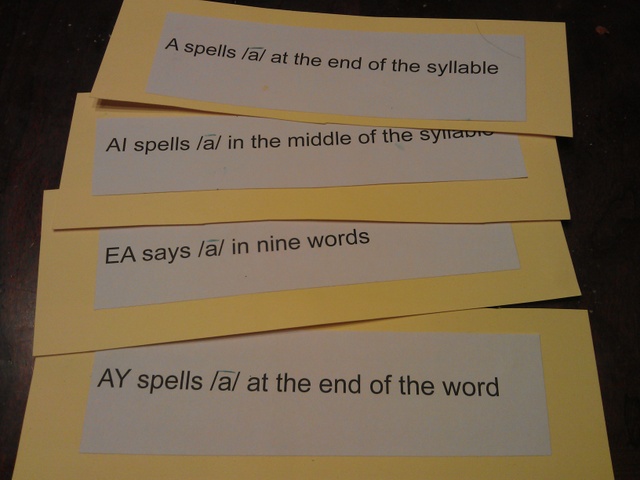
I did make up my own game to practice choosing long A sounds.  I created cards for the various ways of spelling the /long A/ sound that we studied in lesson 4:

And Miss M and Mr. E had to run and grab the card that explained why a word has a /long A/ sound as I announced each word.   It was an okay, active game.  I think I could do something similar with /Long O/ sound words we are now studying in lesson 7.


Helpful Videos:

Logic of English has a YouTube channel.  I found the recent video of LOE author Denise Eide demonstrating how to do spelling dictation to be particularly helpful.  I discovered I was doing the “finger clues” for the number of letters in each phonogram incorrectly.  I also had Miss M watch the video.  She kept trying to tell me that I was “giving away” how to spell the words when I dictated a spelling list to her.  Having only done traditional “spelling tests” in the past, she didn’t quite understand that the point of spelling dictation is really to learn words that she may not already know.  Seeing the video helped her understand that I didn’t just make up some crazy way of teaching spelling words.  😉


ING-ANG-ONG-UNG:

I noticed that Miss M was having a hard time with the sounds associated with the -ng phonogram, so I created a little worksheet to help her.  Mr. E used it as well:

During review lesson #5 I noticed that Miss M would hear a word ending in -ng and have a hard time deciding which vowel sound she was hearing in front of that phonogram. I was hoping that if she created a little visual to go with each sound, it might help her keep the sounds straight.  We haven’t revisited those words yet to see if this helped.  Writing this out reminds me that I need to do that.  🙂


Writing Stories:

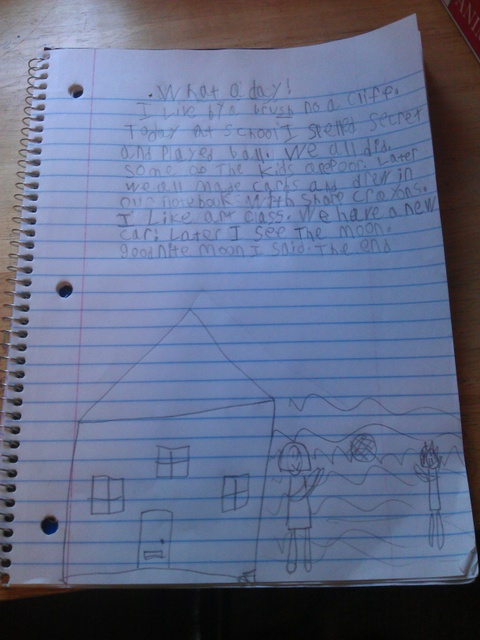
Miss M asked if she could write a story with her spelling words each week.  I said, “Of course!”   She is pretty good about asking how to spell words she doesn’t know but wants to add to the story.  She has written two stories so far — the first contained no mistakes (not counting words we haven’t worked on that she asked about first before writing down), and the second story only contained a couple of small mistakes.  One mistake that was kind of funny to me was her spelling of the word “later.”  She insisted several times that it must be “lader” — because that is how it sounds when she says it!  I had to write down “late” and “later” before it clicked for her!  Maybe “enunciation” or “articulation”  is a subject we’ll have to pay more attention to in the future!


Copywork:

I had Miss M do a copywork page using a suggested sentence to remember the nine words where EA says /long a/:

I’m also planning on reinforcing the spelling rules throughout the year by creating copywork pages based on each rule!


Biggest thing I dislike so far:

So, no program is perfect and I knew eventually I might find something I disliked about LOE-E.   I am finding I really don’t like the format of the workbook so much.  Not the activities themselves — those are fine.  It’s the kind of paper they are printed on and the perforations.

I’ll be honest and say that Miss M has had some moments of frustration while doing spelling dictation (though mostly before we watched the video — that really did help a lot!).  And when erasing needed to happen…the thin paper the workbook is printed on ripped very easily.  I think we have had no less than three out of six spelling dictation workbook pages we attempted to use ruined by ripping/holes during frustrated erasing.

And the pages really don’t stay in the workbook very well.   This is all fine and good I am sure for use in schools where papers are turned in to the teacher.  But I would prefer to keep a workbook together to use for review and reference and that’s just not going to happen with this workbook.  I really appreciate that the cost was kept low for this massive workbook, but I think I am now feeling like I would have gladly paid more for a nice spiral bound workbook with regular paper.

I’m still mulling over my options — I might purposely pull out a lesson’s worth of pages at a time and hole punch them or use my proclick binder on them.  At least they might stay together that way.  It wouldn’t solve the ripping problem, but I am crossing my fingers that we’ll have fewer frustrations in the future.

I’ll plan to share another update in a month or two!


Not-Back-to-School Blog Hop: Curriculum Week August 5, 2012

Filed under: Curriculum — kirstenjoyhill @ 9:45 pm

Not Back to School Blog Hop

It’s time for the annual “Not-Back-to-School Blog Hop” hosted by the iHomeschoolnetwork. This week it’s curriculum week!

I keep a page updated with our curriculum choices, so if you are finding this post later in the year you can check there to see if we continued with these choices!

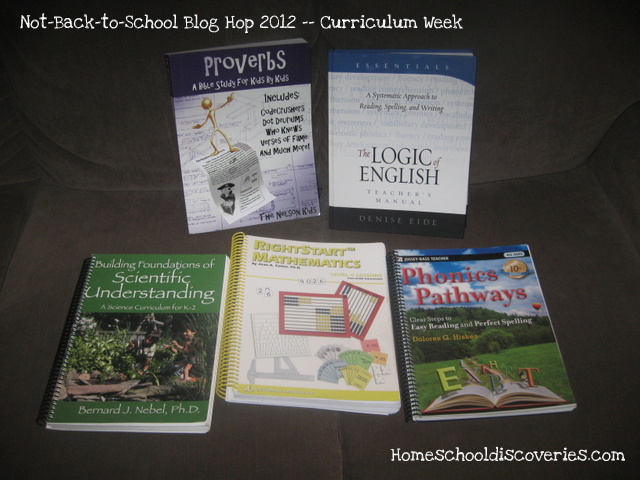
Here’s a few highlights of what we’ll be using this year:

Family Subjects (everyone participates as they are able, at their own level):

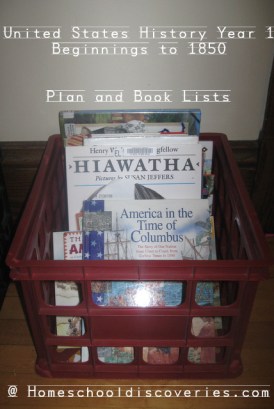
History: United States History Year 1 (Beginnings to 1850-ish) — Using my own outline/plans

Science: Building Foundations of Scientific Understanding (BFSU) — Finishing Volume 1, Starting Volume 2 (Read here to find out a bit more about BFSU and about a resource you might find helpful Collaborative Pinterest Boards!).   We’ll also be reading some science biographies.

Bible Study and Character Building: Various resources from Doorposts books, Hero Tales book series, Leading Little Ones to God, and possibly other resources

Art Appreciation: Artistic Pursuits (Book 2 for Grades K-3)


Miss M, Age 8 (3rd grade, turning 9 in May 2013):

Math: RightStart Math Level C (Read here about why we like RightStart Math!)

Spelling/Writing/Grammar: Logic of English Essentials (Read some of my initial thought about LOE in this post)

Bible Study: Proverbs: A Bible Study for Kids by Kids (from BtoZ Publishing) + daily Bible reading

Handwriting: Cursive practice using copywork related to Bible, History and Science

Literature: Various read-alouds (projected list here) and assigned or free choice individual reading


Mr. E, age 5 (Kindergarten, turning 6 in March, 2013):

Phonics/Reading: Phonics Pathways + Easy readers for practice

Spelling: Learning Phonograms as presented in Logic of English Essentials, Possibly starting spelling lessons in LOE-E as the year progresses

Handwriting: A Reason for Handwriting Book A

Math: RightStart Math Level B

Literature: Assorted chapter book and picture book read-alouds

Fun Printables, Themes and Interest-Led studies as desired!


Mr K, age 3 (Preschool, turning 4 in February 2013)

Lots of Picture books (we’ll have a “classic picture book” of the week)

Letter of the Week Activities (Animal ABCs from 1plus1plus1Equals1, and other letter activities as desired)

Gentle intro to number concepts inspired by RightStart Math A

Fun Printables, Themes and Interest-Led studies as desired!  Possibly a “theme of the month” and a Holiday or Season of the month!


Baby J (Turning One on October 30th, 2012!)

Looking cute, listening to stories, having fun! 🙂


Don’t forget to visit the Not-Back-to-School Blog Hop page to find out what other homeschoolers are using this year for their curriculum!


Ten (sort of) Totally Random Things as I Plan for a New Year July 16, 2012

Filed under: Curriculum,Getting Organized — kirstenjoyhill @ 10:45 pm
Tags: ,

This week’s “10 in 10 Blog Hop” topic from the iHomeschoolNetwork is “10 Totally Random Things on My Mind.”   So for this week’s Top Ten Tuesday list, while I couldn’t bring myself to be totally random, here is a (sort of) totally random list of ten things that are on my mind as I get ready for a new school year.

1.  I searched all over the internet for “Free American History Timeline Figures” and really didn’t find anything I liked.  Miss M really wants a timeline with pictures, but I really didn’t want to buy an expensive package of timeline pieces.  Then when I was searching for science clip art, what did I come across but…Clip Art Etc: A great source of free, educational clip art for history, science and more!  This is a totally legit site from a university with a generous usage license – no ads or inappropriate content to worry about here!  They have a very well organized set of American History clip art I’m excited to use for timelines and notebooking pages this year.

2. I’ll use those free clip art figures in the Timeline Template at Guest Hollow, and follow these directions to mark my timeline book pages…

3….and wall-ah…a nearly-free timeline! I bought a timeline book last summer after being frustrated by the printer jamming when printing lots of cardstock pages, so not completely free.  Now we have a new printer that probably wouldn’t jam, so I could print pages if wanted to.  And I still have a blank timeline book we never used last year.  But Miss M insists we do a timeline so I am motivated to make it work for us this year.

4. Moving on to science, I came up with a brilliant idea.  We use Building Foundations of Scientific Understanding (BFSU) for science.  It is a curriculum with a lot of strengths, but one of its strengths is not easy access to supplementary materials like printables, notebooking pages, example photos, videos, etc.  Users are on their own to find such things.  So I am thinking of putting the power of Pinterest to work and creating collaborative pin boards for BFSU users to make pins related to and labeled for each lesson.  I just need to find the time to create them, add a few pins, and then hope that other BFSU users join in the work/fun to make it a good resource!

5. We don’t have a lot of geography plans yet for this year, other than looking at maps of the US at it relates to US History…Hmmm…I am thinking I might add in a few other geography plans.

6.  After viewing historic planes last Saturday, my kids are totally fascinated with WWII-era aviation.  We’ve watched two documentaries on netflix in the last two days.  The kids keep asking me why we have to study American History “in order”.  They want to skip right to WWII!  We’ll do a little bit of side study of WWII to feed this interest while still keeping on track with the chronological plans I’ve laid out.

7. Will someone please remind me to put labels on our Ikea Trofast drawers we are using for all our school supplies/books? Thanks!

8.  I just realized that the Half-Price books tent sale is this week…Yippee! I love buying books…I am going to try really hard to focus on books that will be useful for history and science studies.  We need more random picture and chapter books like we need more holes in our heads… 😉  But I always make exceptions for the classics!

9. We have a table in our school room but it is like pulling teeth to get the boys to use it.  Miss M has a desk in the school room that she uses most of the time.  Sometimes she uses the table for crafts that take up too much space.  But the boys always (or at least 90% of the time) chose to sit or lay on the floor to do crafts and color or draw.  I’m tempted to get rid of the table.  Except for the fact that Mr. E will need a place to do real school work pretty soon.  Should I get him a desk? Make the table a lot lower so they don’t need chairs?  Any advice?

10. We’re thinking about guitar lessons as a music option for our family this fall.  A nearby park has a family guitar program where Tony can take lessons together with Miss M and Mr. E.  I am really hoping this works out for us.  It seems like a more realistic option right now than bringing a piano or keyboard into the house.

Hop on over to Top Ten Tuesday @ Many Little Blessings to see 10 Random Things that other bloggers have on their minds, and lots of other interesting top ten lists!

Top Ten Tuesday at Many Little Blessings


U is for United States History July 11, 2012

Filed under: Curriculum — kirstenjoyhill @ 8:21 am
Tags:

I am so excited for our coming year of history studies.  There are many, many options to select from in looking for an American History curriculum for early elementary.  But even with so many options to choose from, I still didn’t find just one program that I liked completely!  I liked books from many of the curricula, and each had some books I didn’t care for as much.  Some were more or less expensive.  Some didn’t have the types of written work I was looking for (I wanted some lapbooking, notebooking and other papercrafts/activities!).

But, since I am a planner at heart and I love, love, love looking at book lists…I decided I could plan my own United States History curriculum for this year!  We’ll study American History from the beginnings to about 1850 this year (2012-2013), and study 1850 to the present next year (2013-2014).

I didn’t plan out a week-by-week schedule.  Instead I divided the first part of American History into five units or time periods.  For each unit I planned out various key non-fiction texts, literature read-alouds, literature for my 3rd grader to read alone, materials for use in making a notebook and timeline of what we are studying (and crafty projects too if Miss M would like to do them), as well as a big list of books for a “book basket” of optional reading.

We’ll make sure to work on history in some way each day, working through books from the book list and taking time at least a couple days a week to do something for the notebook (a notebooking page, a lapbook piece, etc).  I’ll be trying my best to keep a record of what we do with weekly or bi-weekly posts, as well as reviews/recaps of many of the books we read.

Want more details on what we are doing? Be sure to visit my “United States History Year 1” page, which has more info and a link to my spreadsheet of books.   And be sure to stop back often this year (or subscribe via email or RSS) if you want to see how this great experiment in D.I.Y history curriculum works out for us!

I’m linking up with Blogging through the Alphabet at Ben and Me (this week’s link-up coming on Thursday).

Blogging Through the Alphabet


Initial Impressions of “The Logic of English Essentials” Curriculum June 7, 2012

Filed under: Curriculum — kirstenjoyhill @ 10:15 am
Tags: ,

At our state homeschooling convention this past April, I made a big investment: I purchased the Logic of English Essentials curriculum and some of its supporting products.  We didn’t have very many weeks to use it before we hit our six week summer break but, it made a big impression on Miss M. When asked about her favorite thing that happened during 2nd grade, she said “finding a new spelling curriculum!”  I was pretty shocked to hear her say this. After all, we did a lot of great stuff this year!  I have to agree though that stumbling across Logic of English is something I’m pretty happy about from this year too.

Our Past Spelling Experiences

Before I get into my impressions of the Essentials curriculum, here’s a little background on what led me to the decision to buy it.  Our first experience with a spelling curriculum came along for the ride with the phonics package I wanted to use with Miss M.  After a few missteps and a bit of experimentation, we hit upon a method of reading/phonics instruction that worked well for Miss M.  We used the curriculum Alphabet Island, which teaches phonics by turning the alphabet into some clever characters.   It then uses a variety of songs and stories to teach various phonics rules and concepts.  This was my first exposure to any type of phonics or spelling rule beyond “i before e except after c” and a few simple statements of that ilk.  I had no idea that there was any sort of pattern, for instance to when “c” or “g” said their hard or soft sounds.

Alphabet Island level 1 got Miss M through reading and spelling three-letter cvc words in Kindergarten.  Then level 2A helped Miss M in first grade to improve her phonics skills to a bit more complex level and start reading and spelling a few varieties of words four letters and longer.  A couple months into first grade, Miss M’s reading ability suddenly took off.  I don’t know exactly how this worked out, but in a matter of weeks she went from solidly sounding out a variety of four letter words, to reading easier chapter books with ease.   We didn’t really need Alphabet Island for learning phonics any longer, but it quickly became clear that Miss M could not spell many, many of the word she could read.

We pressed on through Level 2A of Alphabet Island and started level 2B.  Miss M did weekly spelling lists and filled out workbook pages.  I loved the clever way it presented various spelling rules.  But it wasn’t sticking.  Words that Miss M knew one week were gone the next.  Words correct on a spelling test would be incorrect everywhere else. She didn’t know when to apply which rule.

One thing Alphabet Island does not emphasize is the teaching of all the sounds each phonogram makes.  After a bit of reading and research, I thought a program that teaches phonograms might help Miss M to make improvements.  Being the generally budget-conscious person that I am, I decided to try out “How to Teach Spelling” (HTTS) and it’s companion workbooks. It’s one of several curricula based on the Orton-Gillingham approach to spelling and phonics.

We tried out HTTS for the first few months of this past year (Miss M’s 2nd grade year).  I really can’t fault this curriculum much at all in terms of its underlying principles.   How to Teach Spelling has many of the same underlying principles as Logic of English!  However, it is not particularly user friendly.  I could ask Miss M to fill out workbook pages, but then I had to skip around to various portions of a teacher manual and use some guesswork to figure out exactly which portions I was supposed to use when to somehow teach the rest of a lesson.  The authors recommend teaching all the phonograms and their sounds, but I was on my own to make flash cards or find other ways to accomplish this task.  So, in other words, we really didn’t practice the phonograms much at all.  I didn’t have the time or energy to figure all that out on my own.

After Christmas I pretty much abandoned How to Teach Spelling in favor of just trying to teach Miss M the words she herself was misspelling.  She completed exercises in a writing workbook, and then I would correct her spelling and make lists of oft-misspelled words.  She practiced these words on scratch paper or on the iPad.  But still her spelling was not improving.  She was still spelling the same words wrong over and over again and misapplying the rules she did know.

Enter “The Logic of English”!

Earlier this year, I read Denise Eide’s book, Uncovering The Logic of English.  You can read my thoughts on it in this post, but needless to say it made a big impression on me.   The more I learned about teaching reading and spelling by teaching the phonograms and a few simple spelling rules, the more I wanted to really do a good job of teaching spelling in this way.

And based on my experiences with How to Teach Spelling, I knew I needed a curriculum that would “hold my hand” and tell me what to do each day to make it happen.  Life is just busy around here and while I can fly by the seat of my pants or do my own planning for some subjects, spelling just isn’t one of them.

Using Logic of English Essentials
I started using the Logic of English Essentials as soon as I brought it home from the convention.  After reviewing the teacher manual, I decided we would try and work through the curriculum at the curriculum at the pace of 1 lesson per week with Miss M (finishing 2nd grade, and moving into 3rd grade next year), while simultaneously teaching Mr. E (age 5, just starting Kindergarten) the phonograms.  The Logic of English Essentials teacher’s manual offers a variety of suggested schedules — from an intense remedial schedule that could be completed in a couple of months to a multi-year schedule for younger learners.

I’ve already been teaching Mr. E to read using Phonics Pathways as well as a variety of phonics-based easy readers.  That method is working well for him, so we’ll continue that while incorporating information from Logic of English.  We discuss spelling in informal ways currently, and my gut feeling is that spelling will come more easily to him than it has to Miss M.  I’ll start moving through the spelling lessons with Mr. E once he is reading a bit better and is more comfortable writing in something other than just all upper case printing.  That may be right away this fall, or it may be later — I’m not quite sure yet.

The format of the lessons in the Logic of English Essentials teacher’s manual makes it easy for the parent to pick up the manual and use it without a lot of prior preparation.  Each lesson tells you what to say if you need exact prompts, tells you what materials to use and which activities or workbook pages to complete.  The lesson is divided into several parts, making it easy to spread the lesson out over a week or more and still know what to do each day. The only prior preparation that may be necessary is sorting through the phonogram flash cards (and game cards if you are going to use any) to find the new sounds you want to add to your “deck.”  The first week I didn’t do this ahead of time, and I had some frustrated students on my hands while I looked through a big stack of cards and decided what we needed.

Each lesson generally seems to follow the same basic format, so even after just three lessons (aka three weeks of use), Miss M seemed very comfortable with the process and knew just what to expect.  Each lesson has several “optional” exercises as well as the main exercises if students need more practice in certain areas.  Grammar and Vocabulary development activities are included, but you can omit those if you prefer or spend less time on them.  With the grammar in particular, we will be just lightly covering this material as I have plans for more in-depth grammar study once Miss M reaches 4th grade.

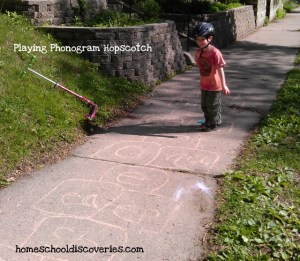
I bought the optional, but very useful, Phonogram and Spelling Game Book as well.  Not every lesson incorporates games, but if you have a younger learner or a learner who finds games to be a very useful method of study having the game book will be very useful in finding additional ways to practice.  The book features card games, paper games (like bingo), games that could be played with a chalk/dry erase board and active games for learning while playing something like hopscotch.  I like the fact that the games can easily be tailored to multiple ability levels.  I expect Miss M to know all the sounds a phonogram makes, I allow Mr. E some leeway to remember “most” of the sounds (as a five-year-old it is taking him a bit longer to remember all the sounds for some of the phonograms that have three or four sounds!) and I can even include Mr. K at times as he is beginning to learn the names of letters and perhaps one sound that each letter makes.

Q and A about Logic of English Essentials

I’ve been gushing to friends about our new spelling curriculum, and they have asked some good questions.  I’m guessing that other people may be wondering about some of the same things:

Is it worth the money?

This is a big question on many people’s minds! Logic of English is more expensive than some “basic” spelling programs.   The teacher’s manual and one workbook without any extras runs $120.  However most of those “basic” spelling programs either require more teacher prep/decision making (as I discovered with How to Teach Spelling) OR they are not phonogram/rule based.  If you have a student who needs direct instruction in spelling (aka they aren’t just a really natural speller) and you want the benefits of a rule/phonogram based spelling program and you want the prep-work done for you, then clearly this is worth your money.

If you have a student who seems to excel with weekly spelling lists or just remembers easily how to spell words, then this whole program might not be worth the money.  However, I believe that everyone could benefit from the basic principles outlined in “Uncovering the Logic of English”, so you could just consider purchasing Denise Eide’s book and teaching your student some of those rules and principles to give them the “why” behind the words they already know how to spell.

Also, keep in mind you are getting big, high quality books for your $120.  The teacher’s manual is a large, sturdy, hardcover book. It should hold up well over use for multiple students and I would guess retain its resale value well because it won’t be falling apart.  The student workbook is definitely consumable, but again, you are getting a big book for your $25.    You might be able to just use a notebook instead or have students write their work on a dry-erase board, but I have seen much smaller/thinner workbooks sold for a similar price!

Purchases of the supporting materials for this curriculum do add up a bit as well (phonogram cards, rule cards, game cards, etc).  Other than the Game book, many of the other “extras” could be made yourself if you have time on your hands.  If time is on your side, go for it.  But if you are limited on time as I am with four kids, then it seems very worth while to just have all the phonogram cards and so on ready to go!

How much time do you need to spend each day on spelling? Can the student work independently?

The amount of time spent will depend on the schedule selected.  If you want to go with the fast-paced remedial learner schedule, Eide recommends as much as an hour or two per day.  For the schedule we are following, 30 to 60 minutes per day is recommended.   I find that we are spending about 30 minutes per day, unless we are playing a game that takes longer to complete.  A portion of the lesson (mainly workbook practice) can be done independently but the parent will be spending a majority of the lesson time with the student.  Time spent with younger students will vary depending on their patience and readiness.   Mr. E’s patience so far for practicing phonograms or playing games is rarely longer than 15 minutes or so.  That’s fine, since I don’t expect a five year old to move through the material very quickly.

Have you found any similar programs? Who would or wouldn’t like Logic of English?

The program I most often see Logic of English compared to is All About Spelling.  Both programs have a lot of the same underpinnings, but teach the material differently.  All About Spelling is divided into more levels that are individually less than the cost of this program, but purchases of those levels will quickly add up as well.  I have not used All About Spelling so I can’t really fairly compare the two.  If you are looking for a rules/phonogram based spelling program, however, that is probably the other program you would want to check out.  As you read about both, you can find out which program’s approach and teachings methods appeal more to you and your students.

If you are looking for a program with a limited amount of writing, then Logic of English Essentials might not be the program for you, though you could conceivably do many of the exercises in modified ways if you have a student that struggles with writing.

If you don’t like having lots of pieces and parts to keep track of, then you might find the “games” aspect of this program annoying — but the program should work without the games, so don’t let that alone keep you from checking out this program.

It’s also not a program that can be completed independently, as I mentioned earlier.  You need to make sure that you as the parent have the time to spend teaching your student.

How well do you think this would work as a stand-alone curriculum to teach a younger student (Preschool or Kindergarten) how to read and spell?
Logic of English essentials does have a schedule for younger students to complete the program over the course of two years.  I think using the program with younger students is not quite as “open and go” as it is for a bit older students who already know how to read and have the maturity to sit and complete 30 minutes of spelling work.  First, you would need to make sure your younger student can recognize, know the sounds of, and probably also write the letters A to Z in lower case. Students also need a basic level of phonemic awareness (activities are included, but not extensively scheduled out). You would then have to decide how to break up the parts of each lesson into smaller chunks and when to add additional games.

Since Logic of English is primarily a spelling curriculum, you would at minimum need to add plenty of phonics-based readers for practicing blending words together.  LOE Essentials moves in one lesson from mostly three letter words to four and five letter words.  Based on my limited experience, most beginning readers need lots of practice at the CVC or  “three letter word” blending phase, and additional practice for consonant blends, and so on. While the building blocks (the phonograms and rules) are presented, you would be “on your own” to practice these concepts.

I have a suspicion that most parents would be happier using some other curriculum prior to or along side of Logic of English Essentials for teaching a younger student to read.  I would suggest checking out Phonics Pathways or The Ordinary Parent’s Guide to Teaching Reading, as these programs will provide more step-by-step reading practice.

Have any other questions? I will try and answer them in the comments, or check out the Logic of English website, including their forums!


P.S. (Added May 12, 2013):  We’ve now been using Logic of English Essentials for over a year! Read my one-year-later update here.

 

N is for Next Year May 23, 2012

Filed under: Curriculum — kirstenjoyhill @ 8:24 am

We’re finishing up our current school year….so it’s the perfect time to think about next year, right? Next year I’ll have a third grader (Miss M), a Kindergartener (Mr E, who will be working above that level in many areas), and a young preschooler (Mr K will be 3.5 at the start of the new school year).  And of course baby J will still be the baby of the family (though he will be more like a toddler by the time I am writing next year’s next year post!).  🙂

Some of my curriculum decisions were very easy, as we are continuing right on from where we are now:

For math we use Right Start.  Miss M completed a little over 100 lessons in level C during her 2nd grade year.  We’ll pick up Level C right where we left off, and then move on to Level D.  Mr E seems like a natural at math.  We’ve informally used level A this year.  I am currently planning on starting Mr E with Level B (also a starting point for Right Start Math), and seeing how that works out for him.  If you want to read more thoughts on why we like RightStart, check out this post.

For spelling (as well as some grammar/composition), we will be using the Logic of English Essentials curriculum.  This is not exactly a continuation, since we’ve only been using it since mid-April.  But once I bought it, I just couldn’t wait to try it out! We’ve done a few formal lessons, and will continue to learn/review the phonograms and play games during our six week break.   This is a new curriculum, and judging from the search terms people are using to find my blog,  readers want to know more about it!  I’m hoping to post a review with a few more detailed (albeit initial) thoughts within the next week or two.  Miss M will be using this curriculum fully, and I will be including Mr. E as best as I can.  He will not be able to move as quickly as Miss M, so it might be a challenge to use it to its full potential with him this year.

I don’t plan on doing any other formal grammar or composition/writing curricula with Miss M this year.  My plan is to begin more detailed grammar study in 4th grade.   Since Miss M findings writing to be very frustrating due to her difficulties with spelling, the composition exercises in LOE  as well as copywork and incidental writing for history or science will be plenty until her spelling improves.  If we see a marked increase in her spelling abilities and confidence, I may assign more writing.

For phonics/reading with Mr. E, we’ll continue with Phonics Pathways, until it proves to be unnecessary or no longer useful.  We’re currently up to page 95, and working on long vowel sounds. Of course, we do lots of practice outside of the Phonics Pathways book with easy-readers I have around the house or check out from the library.

For literature/read-alouds, I will do as I did this past year and make a list from the many sources I’ve found to inspire book-list-making.    I’ll make lists for read-alouds with Miss M at bedtime, read-alouds for the whole family (or at least the two older kids), and books I will ask Miss M to read on her own.   I’ll be planning some of our choices to coincide with our history studies.

For science,  we will continue with Building Foundations of Scientific Understanding (BFSU).  We are close to finishing Volume 1 (we may finish it this summer), and we’ll start volume 2 after we finish it.   I haven’t written about BFSU on this blog yet, but I’m sure I will get to writing about it eventually. 🙂  Science is a family subject for us taught primarily by my husband.

Some decisions are a bit harder, as they involve finding new resources and making decisions from among many options:

For history this year, I know we will study American history from the explorers and native people to sometime just before the Civil War.   I know I want to incorporate a lot of literature.  I know I want to use lapbooks/notebooks and maybe a few hands on projects or other experiences.  I also know that I haven’t found any one curriculum or list or curriculum package that is just what I want… and I have spent hours researching the options!

I’m not sure I’ve even found a spine or key text that  I like.  I am confident in my ability to put together a list of books, so if all else fails we’ll just do that.  Currently, I am intrigued by “A Living History of Our World: America’s Story Vol. 1”  by Angela O’Dell.   But I haven’t gotten my hands on a copy yet to see if meets the many criteria I have for a US History text!  Overall, I will be planning our history studies with Miss M in mind, but I am hoping for spine text that Mr. E can reasonably join us for, as well as asking him to join us for some read-alouds that he will find interesting.

For Bible and character growth, I will continue to ask Miss M to read her Bible each day, and will aim to read the Bible to Mr. E (and Mr. K if he chooses to listen).  Maybe before the year is out, Mr. E will be reading it on his own! I’ll also be adding in an assigned Bible study for Miss M.  I bought a Proverbs Bible study for kids from B to Z publishing at our regional church conference this winter, but we haven’t used it yet.  I think I will be having Miss M work though this workbook next year.  At the MACHE homeschool conference I bought a few resources from Doorposts Books that I hope to worth through as a family the summer and into the next school year as well to continue building Godly character qualities into our kids!

For handwriting and and copywork…I am wavering in my decision.  Miss M has used A Reason for Handwriting Level C to learn cursive, and I have been pleased with it overall.  So much so that I bought Level D for her continued practice and Level A for Mr. E to practice printing.  Then I started to wonder if I wouldn’t rather assign cursive copywork to Miss M based on Bible verses I would like her to learn or copywork related to history or science.  Also, the Logic of English Essentials curriculum recommends starting with cursive first, so I am not quite sure what I want to do with Mr. E.  He already knows his manuscript uppercase and some lowercase letters.  At first he wanted to learn cursive…now he’s not so sure.  I’ll keep both books for now and think on it a bit more before fall.

For preschool with Mr. K and some “fun” Kindergarten stuff for Mr. E, I’ll be using free printables from some of my favorite sites (I hope, if I can manage to get organized enough to do that!).   I’m also mentally tossing around ideas about how to incorporate some literature based or topic based unit studies/delight directed studies.   Despite their difference in academic ability levels, I think topic-wise Mr. K and Mr. E should still have a lot in common for their interests and types of books that will hold their attention for literature based studies.   I’m not too concerned with actual “preschool” skills for Mr. K…if he learns a few more letters and numbers that’s great…if not well…he’s still only three and has plenty of time to learn!

Health and P.E. are part of the Minnesota state requirements of what you agree to do if you are homeschooling.  We fulfilled this requirement informally, through our co-op and through science lessons (in the case of health).  I’m not sure if I’ll plan something formal for these subjects or not.

I don’t have any formal plans as of right now for art and music.  My kids do a ton of art and crafts on their own (as well as doing art at our co-op).  I have materials on hand for art instruction if they ask for it.   The jury is still out as to whether or not Miss M will begin piano lessons this coming year (we don’t even have a piano or keyboard yet, so it is a theoretical discussion indeed at this point!).   I would love to incorporate more art and music appreciation into our homeschool, but I know from past failed attempts that it is easier said than done!  I’m still pondering whether or not I want to make a formal attempt next year.

I’m linking up with Blogging Through the Alphabet @ Ben and Me!

Photobucket


How We Picked a Math Curriculum Part 2 — Choosing and Using RightStart Math April 25, 2012

Filed under: Curriculum — kirstenjoyhill @ 1:49 pm
Tags: ,

About two months ago, I wrote about our initial attempts at finding a math curriculum that would work for us.  I’ve been meaning to write the second part…but I kept putting it off in favor of more time sensitive posts.  I made it one of my goals for the week to get back writing it!

As I mentioned in my previous post, we had already tried Saxon Math K and Kindermath, so when Miss M was a few months into Kindergarten, I knew a little bit about what I was or wasn’t looking for in a math curriculum.

I knew I wanted something that was more on the “mastery” side of the spectrum, rather than something as far down the “spiral” end of the spectrum as Saxon Math K proved to be (read this article if you aren’t familiar with those terms). But I also didn’t want something so “mastery” oriented that we would be doing the exact same topic for months on end.

I was looking for a curriculum with a strong emphasis on mental math.  I liked the idea of having plenty of manipulatives to use (that was something I liked about Saxon K).  At that time I was also looking for something without tons and tons of writing.  As a K’er  Miss M really struggled with writing numbers, and tired of doing so very quickly.  I didn’t want her math progress to be hindered by her writing struggles, nor did I want to spend excessive amounts of time being her scribe for worksheet after worksheet.

After doing a bit of research, I first narrowed my choices down to RightStart and Singapore Math.  Singapore is more workbook based by far than RightStart, but all the good reviews and the ways it met my other criteria caused me to give it serious consideration.  I looked over both programs with my husband.   He was impressed with the research behind the creation of RightStart, and we both thought the use of the abacus and the card games as a method of reinforcing concepts was very intriguing.

We purchased RightStart level A in January 2010.  Since Miss M had some previous math experience, we were able to fly through level A fairly quickly.  We finished nearly all of it in the last 5 months of her K year.   We completed Level B last year when Miss M was a first grader, and we are currently working on Level C.   This year I started Mr E (just turned 5 in March, so still technically a “preschooler”), casually in Level A. We do parts of various lessons when he shows interest, or I just keep the concepts in mind and talk to him about them as he asks “mathy” questions.

In general, we’ve been very pleased with RightStart Math.  It is a bit more toward the middle of the “spiral-mastery continuum” than I initially thought it might be, but it is still “mastery”-oriented enough to provide adequate practice on various concepts (especially when one considers the daily warm-ups and extra game playing possibilities) while also giving variety and covering important topics like measuring, time, calendars and geometry.

RightStart does take a lot of  direct teacher instruction, at least in the levels we have done so far.  I’ve heard that some parents have had some success at the higher levels in giving an older student the teacher’s manual and letting them work through the lesson independently.  I find that I need to plan on 20-30 minutes of focused attention with Miss M most days, and some days we may spend longer (especially if we play a game or deal with “attitude issues” we need to work through!).  Some users find the they can write out the daily warm ups to save on some of that teacher-intensive time.

It is hard to find time to play the games.  We love most of the games (though we have found a few to be boring!), but unless a game is directly called for in the lesson, we honestly don’t take the time to play them as often as we should.  It’s very helpful that Mr. E is now old enough to play some of the games with Miss M (sometimes I help Mr. E on harder games or give him a “cheat sheet” of some sort).  However, it is often very hard to keep Mr. K out of things.  He insists that HE wants to play too.  But even with help, he doesn’t have the patience or self control to really play the games.  More than one math card game has been destroyed by a careless or reckless toddler before the game was finished.  That’s very frustrating for the game players!  The best we can often do is to distract Mr. K with something else (he stopped napping well over a year ago, so that’s not an option for us), which may or may not work.

We’ve had some frustrating days in Level C to be sure (though I am sure this would be true of any math curriculum!).  Some days I know I have to have some trust in the process. Even though playing games and learning the multiples of each number and doing subtraction on an abacus isn’t how I learned math, I can see that it will probably produce kids with true understanding of what’s going on with the math, not just an ability to fill out a math test in school.

As of right now, my plan is to take a break on new lessons from level C with Miss M over the summer (we’ll still have somewhere between 20-35 lessons left, depending on how the next five or six weeks go!).  I’ll have Miss M do the “B-side” review pages from throughout level C, as well as math facts practice over the summer (hopefully via some games!), unless she requests new lessons.  Every six days the RS C student manual has a review page with two sides that cover the same concepts, just different problems.  All year we only did the “A-side” of these review sheets, leaving the opposite sides conveniently blank for summer review.   Casual math for Mr. E will continue as he has interest over the summer.

Then this fall Miss M will complete level C, and begin level D immediately after (we already have it ready and waiting!).  I will most likely start Mr. E in level B this fall.  Level B can also be a direct entry point for the Right Start sequence.  Given how quickly he grasped the material in the lessons/discussions we have done so far, I think we either might fly through level A if we continued there more formally or he might get frustrated by the slow pace.  I will try him with level B, knowing that we can slow down and/or play games as necessary if it gets too hard too fast.  We can always go back to level A if it’s a disaster.  😉

Even if you aren’t in the market for a new math curriculum but you like card games, I would encourage you to check out their games book and kit.  The Right Start games could be a fun supplement to any curriculum, and the book contains games to practice almost any elementary math concept!