Homeschool Discoveries

Sharing a few things I've discovered along the way…

American History Unit 2 Recap: Early Settlers and the Colonial Period October 25, 2012

Filed under: Books,History — kirstenjoyhill @ 9:56 pm
Tags:

Our second unit or topic for our US History studies this year was the early settlers through the pre-revolutionary colonial period (approximately 1609-1780 — Check out my post last week about our studies of American History prior to European settlement).  We just finished this unit up the week before last (although last past week we were still finishing up a couple read alouds that fit with this time period).

I originally planned nine weeks for this unit — that turned out to be way too long! We ended up spending about five weeks (or was it six weeks?) on this topic.  The vast majority of books we found for our “book basket” in particular focused on the topic of the Pilgrims and the Mayflower (and fewer about Jamestown, the Puritans, the French and Indian Wars, and everything else in between).  And we read two longer chapter books about the Puritans. So by about the fourth week, Miss M let me know that she felt like we had been talking about Pilgrims and Puritans  forever.

Here are a few highlights of the resources we used:

Longer Read Alouds (links to my blog posts about these books):

Longer  Books Miss M read Independently:

  • Pocahontas and the Strangers
  • A Lion to Guard Us
  • Skippack School (might be classified as a long picture book.  The copy we had from the library was old and gorgeous.  I meant to read it also before we had to return it, but I might have to get it again to read it sometime!)
  • Courage of Sarah Noble
  • Fire by Night (from the series, The American Adventure)

Miss M enjoyed all these books, and although I am not sure she would have picked any of these completely on her own, she seemed eager to read them most days.  I keep forgetting to ask her which was her favorite — but just judging by her tendency to read more than the minimum assigned amount of reading on a given day, it might have been Pocahontas the the Strangers.

Picture Books:

We again had a full book basket of picture books for this topic, weighted heavily toward books about the Mayflower and the Pilgrims.  Miss M’s favorite books were again titles from the “If you lived…” series, while the boys really enjoyed the humorous tone of “You wouldn’t want to Sail the Mayflower”.   We also read two titles in the American Story series by Betsy and Guillio Maestro — The New Americans and The Struggle for a Continent — to give us an overview of the entire time period.  The boys particularly enjoyed the latter due to all the information about battles in the French and Indian wars.  🙂 A somewhat complete list of books we had in our book basket can be found in the file linked to on my US History Year One page.

Other Activities:

Despite spending a lot of time browsing through craft and activity books, Miss M only selected one craft during this unit.  She made her own ink using strawberries, and then used a feather she found as a quill pen.

We didn’t attempt any other written work during this unit.  Miss M has little interest in notebooking or lapbooking at the moment.  I am encouraging a bit more notebooking for science, so I am not going to force it with history.  I ask her to tell me about what she read (oral narration) and we are calling it good at that.

We’re also not making much progress on a timeline.  Miss M seemed excited about making a timeline at first.  But when the rubber met the road and I couldn’t provide printables to glue in the timeline that were exactly what she had in mind, she wasn’t very motivated.  I still might stick a few dates in myself.  🙂

Given that we’ll cycle back to American History about four years or so, my main goal is just exposure and introduction to the key concepts.  I’m imagining that by middle school (when we do American History again) Miss M will be far more ready for serious notebooking, timelines and maps!



Book Discoveries this Week: Non-Fiction Picture Books October 18, 2012

Filed under: Books — kirstenjoyhill @ 1:12 pm

We’ve read quite a few interesting picture books from the non-fiction section recently, so I thought I would share a few on a hodge-podge of topics today.  🙂

We had a “Fraction Fun” day yesterday (look for a post coming soon about that!), but I wasn’t really on top of requesting any thematically-appropriate books from the library.  So, we read a different math picture book instead!

Mr. E and Miss M both really enjoyed You Can, Toucan Math by David Adler.  Each page features a math problem written in rhyme with an illustration that gives clues to the solution.  My kids like “story problems” (as I remember calling them when I was a kid!), but our math curriculum (RightStart) doesn’t use as many of these as do some curricula.  Books like this make a fun supplement!

Most of the math operations were in the “easy and fun” category for Miss M (3rd grade), while some were a bit over the head of Mr E, but he figured out the answer to a good many of them (He’s in Kindergarten, but is advanced in math).

I’ve mentioned the American Story series of picture books in some of my recent posts about our history studies, but I think they bear mentioning again.  This seven book series of American History picture books by Betsy and Guilio Maestro covers the time period from the era before Europeans arrived to about 1815.  These books are fairly detailed, but not so much that Mr. E can’t follow it.  Even Mr. K (age 3.5) will sit and listen — especially if fighting is involved.  🙂  The pictures are really gorgeous in these books.   Even though they are picture books, they are not “too young” for Miss M by any means.  I even learned a lot from reading  Struggle for A Continent, a about the French and Indian wars (a time period I had never learned very much about!).

We find a lot of interesting science books in the non-fiction section — some are more memorable than others.  One series I actually  like is the Cat in the Hat’s Learning Library.  Now before you throw tomatoes for liking something that seems a bit inane, hear me out.  🙂  Okay, yes these are not classic Dr. Suess by any means, but I really admire how they work a ton of information into rhyming format in this series.  I would much rather put up with a few slightly off kilter rhymes than some of the dull sentences I’ve read in other science non-fiction books.   We read three of these books in conjunction with our science studies in the past few weeks:  Is a Camel A Mammal, Oh Why Oh Why Are Deserts dry and Safari So Good. These books are a good read aloud for my Pre-K and K’er, and even my 3rd grader really enjoyed reading them on her own.

From the Biography section a recent favorite was Wanda Gag: The Girl Who Loved to Draw, by Deborah Kogan Ray.  Wanda Gag has always been a bit of a favorite of mine since she hails from a town I called home for about four years a child — New Ulm, Minnesota.  This book does a great job telling Gag’s life story, Miss M read it several times, Tony read it aloud to the boys…then I just had to read it to myself!

Finally, just one fiction selection for this post (to go along with the previous non-fiction selection).  You may have already read Millions of Cats or the ABC Bunny — two of Gag’s most well-known picture books.  But have you read, The Funny Thing?  I really love this story.   An old man named Bobo is horrified by a strange creature (an “aminal”) that eats the dolls of children.  Playing on the creature’s vanity, Bobo convinces him to eat “jum-jills” instead.   Very tasty, these jum-jills!  (A phrase that fills your head after reading this book!).  🙂

I’m linking up with Read-Aloud Thursday @ Hope is the Word.


American History Unit 1 Recap: Native Americans/Explorers October 16, 2012

Filed under: Books,History — kirstenjoyhill @ 11:03 pm

Despite the best of intentions to keep track on a weekly or bi-weekly basis of our American History reading and activities, we’ve now finished two “units” or topics of our self-designed American History studies without a post detailing what we did.

I’ll share a few thoughts here about our first unit (as much for my own benefit as for anyone else’s — so I can remember what I might want to change as we come back around to American History in a few years!), and you can also refer to my general overview page of our US History studies for the year.  I’ll be following up soon with a post about our second unit about the early settlers/colonies.

My goal with our first topic — Native Americans and Explorers — was to expose the kids to some information about what was going on here in North America before Europeans came to stay.  We had read about some of the early European explorers of South American and Mexico last year in Mystery of History Vol. 3,  but I purposely skipped over Christopher Columbus and the early North American explorers to save them for our US History studies.

Next time around, I think I might do things a little bit differently.  I think I would incorporate the explorers into world history of that period (with MOH III or another resource), and spend less time at that point on the American Indians.

When I planned the schedule for this year I didn’t realize, first of all, how many of the resources available regarding various Native American tribes are full of information about how these people groups lived after the Europeans arrived.  Secondly, there are many opportunities to read about Native Americans throughout the settlement/colonial period and beyond.

A few resource highlights:

I assigned Miss M to read Pedro’s Journal and Conquista.  She didn’t really enjoy either one of these very much! I also expectd her to read the Kaya American Girl books, but after reading part of the first one, she let me know that she really wasn’t interested.

Miss M also read a number of shorter non-fiction and fiction books from our book basket.  She really likes the “If you live with…” series of books such as “If you lived with the Sioux”, as well various picture books focusing on Native American legends. She didn’t care as much for some of the other informative books I selected from the library on various tribes and explorers.  The boys also occasionally asked for some of the book basket books to be read to them, but not super often during this unit.

We only completed one chapter book read aloud during this unit, and started one more that we elected not to finish.  You can read more about these two books in this post.

My favorite “overview” resource is The American Story series by Betsy and Giulio Maestro. This series of picture books takes American history from the time before European explorers to 1815 over the course of seven books.  We read the first two for this unit.

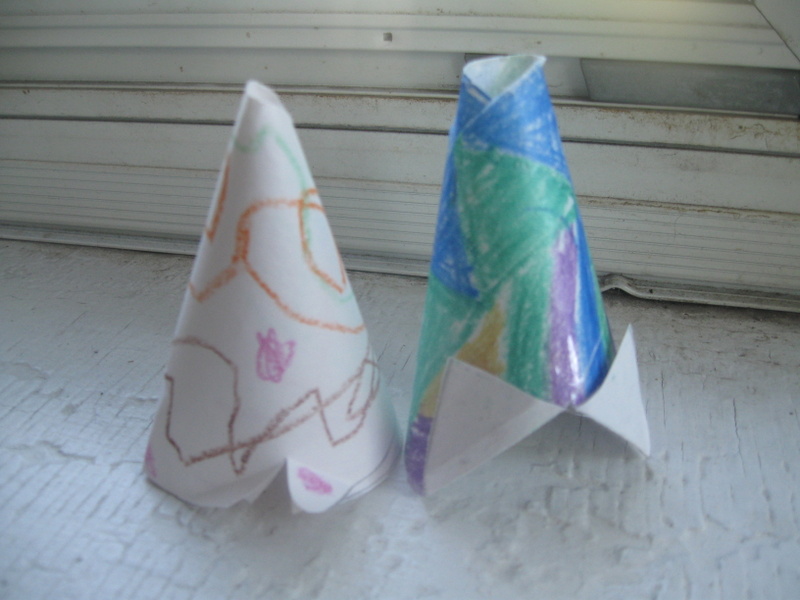
As far as written work or projects beyond all our reading, the kids did do one project from the Native Americans History Pockets book (which Miss M declared to be “far too easy.”).  There was very little interest from Miss M or Mr. E in completing any other written projects (lapbook pieces, notebooking, other History Pockets).  The kids did do a few crafts from the book “More than Moccasins,”  like these paper tepees.

In our history studies so far I’ve been amazed by my kids lack of interest in doing much of any written/tangible work or projects.  I’m not going to force it or make a big deal — after all, I am pretty confident that my kids already know more about early American history than I did up until this year since due to various moves as a child I never had the “first half” of American history with much of any depth at all (though I had the “second half” of American history twice!).

We completed this unit about a week or two ahead of what I had originally planned.  Given that we also finished up our second unit a few weeks early (i.e. we had read nearly all the books on our list and the kids were getting tired of that time period), I think I may have planned too long for each unit on our schedule!  Miss M told me the other day that she was worried about what would happen if we studied US History “too fast.”  I let her know not to worry — there is still plenty of American history left, and even if we get further in time this year than I originally planned, I can easily find good history or geography related studies to fill our time.  🙂


Top 10 Book Series Picks for New Readers

Filed under: Books — kirstenjoyhill @ 8:20 am
Tags:

I’ve found that looking for books for new readers can be a hit-or-miss process.  The “level number” on the front of a lot of books in the easy reader section may or may not really mean anything, as there is so much variation in what those level numbers designate.   A lot of books I randomly find in the easy reader section at our library seem designed to promote guessing based on clues from the pictures or memorizing “sight words” — which is not particularly helpful if you are teaching reading through phonics rules and phonograms.

Here are my top ten picks for easy-reader books that I have found helpful and engaging for my early readers who are learning via phonics:

1. Now I’m Reading books by Nora Gaydos: These sets of small books are great starter books (at level 1), and progress gradually.  At least in the first couple levels, the books start out with just a couple words on the first page, and build to longer sentences.

2. BOB Books: These popular little books are also great for kids just starting out — Though for some reason neither of my kids (who have learned to read so far) have really “clicked” with the first set as beginners.  I used sets 2 and 3 from the library with both Miss M and Mr. E, and I just got sets 4 and 5 from the library to use with Mr. E once we finish up a few other books we’ve checked out.

3. Flip-A-Word Books by Harriet Ziefert and Yukiko Kido: We found this fun word-family based set of books at the library.  They have bright/bold  illustrations and fun “cut outs” that reveal new related words.

4. My Phonics Readers (Various Authors, New Forest Press): This is another series we discovered at the library.  My favorite feature of this series is a box at the beginning with “difficult words” that appear in the book.  I love that they don’t call these “sight words”!   Mr. E has read several of these and I appreciate being able to review these tricky words before he begins reading.

5. Sounds Like Reading: This Series by Brian Cleary each focuses on a word family, sound or type of word.  Each two page spread first gives the focus words for that page individually, then the words appear in a sentence.  Many of the sentences are funny, which is appealing to my kids!

6. Wonder Books Phonics Series:  This is yet another series we discovered at the library. Each of these books focuses on an initial consonant, vowel sound or blend.  I don’t like this series quite as much because it mixes some surprisingly harder words in with words easy for beginners, but as a plus in their favor, each page has one short sentence in fairly large print.   Mr E gets easily overwhelmed with too many words on a page, even words that he already knows.

7. Get Ready-Get Set-Read series by Gina Erickson: We only have one book in this series so far (that we found at a used book store — our library doesn’t have these), but I like that they are phonics based with just a few challenging words.

8. I See Sam:  I recently wrote about this set of free printable books.  I love having a set of books I can print out when we run out of library books to read.  These seem somewhat repetitive to me, but Mr. E finds them funny!  I like that the books in this series we used so far focus on words like “that”, “who” and “what” — common words that are just a bit trickier than CVC (consonant-vowel-consonant) words, and introduce new words and phonograms slowly and logically.

9. Dr. Maggie’s Phonics Readers: We own several of these phonics readers, but mostly the later ones in the series.   Mr. E hasn’t liked this series quite as well as some of our other series due to longer sentence length and more words on each page.  But I think they are a solid series for readers who are ready for them (and I haven’t seen the first books in the series, so they may have fewer words per page).

10. Reading A to Z decodable books. Reading A to Z is a pay-for-subscription site, but they offer a seven day free trial, and also have an annual “try it out” day for educators.  I’ve downloaded and printed several of their decodable books a few years and used them with both Miss M and Mr E.   I don’t think I would get enough out of the site to pay their annual subscription rate, but I do like this particular printable product.

Have you found other series of phonics-based readers that your new readers have enjoyed?

I’m linking up with Top Ten Tuesday!
Top Ten Tuesday at Many Little Blessings


Book Discoveries this Week: The Witch of Blackbird Pond October 12, 2012

Filed under: Books — kirstenjoyhill @ 5:05 pm

Miss M and I continued our reading in the Puritan era of New England with The Witch of Blackbird Pond by Elizabeth George Speare.  This Newberry-award winning book takes place in Connecticut in 1687.  Things seem to have relaxed just a bit in the Puritan colonies compared to the time we read about in our last bedtime read aloud, Puritan Adventure.

(I just looked back at my last Book Discoveries/Read Aloud Thursday post, and I think we finished that one about three weeks ago…so this was a long read — though there were a few nights we missed reading together!)

But like Puritan Adventure, The Witch of Blackbird Pond is the story of an outsider who doesn’t quite fit in.  Kit grew up in Barbados, raised primarily by her grandfather.  After her grandfather’s death, Kit decides to travel to New England to live with the only family she has — an aunt and uncle she has never met.

Kit often feels out of place, and befriends others who feel out of place — including an old woman living alone near the pond.  Hannah, the so-called “witch” of blackbird pond is really not a witch at all.  She is, however, a Quaker — someone the townspeople dislike just as much apparently (and this difference of belief leads many people to let themselves think she must be a witch).  Kit subverts her uncle’s desires and continues a friendship with Hannah, while meanwhile she tries to maintain a respectable face with her family and in the town.  She teaches in the dame school, and is courted a wealthy young man in town.

There are themes of romantic love in this story (both for Kit and for her two cousins), and of course the battle Kit faces between her free-spirited upbringing and the “respectable” life she should be learning to lead in New England.

Early on in the book I wondered if this book would be a bit much for Miss M to follow (the love stories are a bit complicated, as well as some of of the political disagreements the townspeople have), but she kept telling me she was enjoying the story and wanted to know what would happen, so we pressed on.  This book was much easier to read aloud than Puritan Adventure, since Speare made very little attempt at period dialog in her book!

I’m glad we read this book, though I think we easily could have saved it for our next go-around with American history in three or four years — I think a middle-schooler would really enjoy this as an independent read.  And very likely Miss M will read it for herself anyway when we get to that point.  🙂

Totally not important — but I really like the cover image above…the copy of the book we have (purchased at a thrift store) has this cover.  Much uglier!

I didn’t really plan it this way, but we have been reading another book by Speare — Sign of the Beaver — simultaneously.  Sign of the Beaver is a much easier read-aloud to follow, and I’ve been reading it to all the kids.   We’re close to being finished with that one, but not quite…so I’ll save discussing that title for a future post.  🙂

I’m linking up with Read Aloud Thursday at Hope is the Word!


Book Discoveries this Week: Puritan Adventure by Lois Lenski September 21, 2012

Filed under: Books — kirstenjoyhill @ 5:21 pm

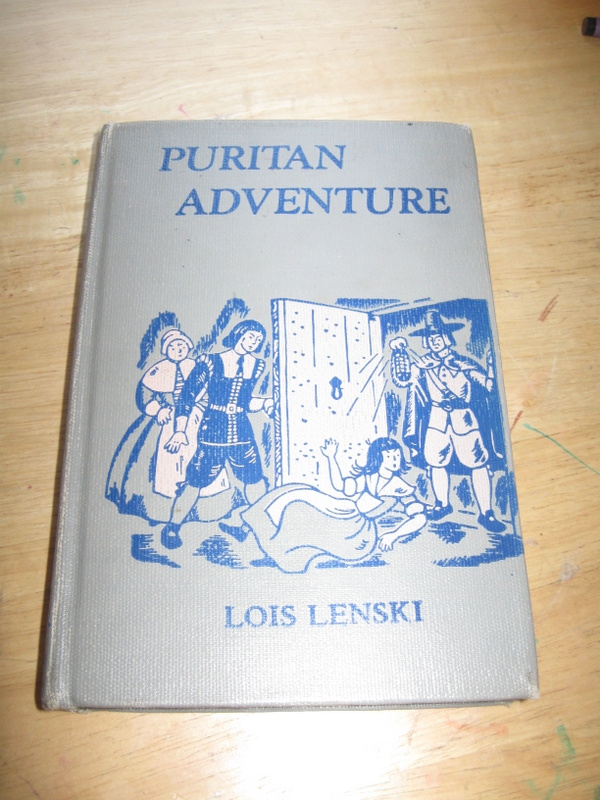
Miss M and I finished reading Puritan Adventure by Lois Lenski earlier this week.   This was a title I found via All Through the Ages, a great book for finding suggestions of both fiction and non-fiction read-alouds for any time period.

Puritan Adventure takes place in the Massachusetts Bay Colony in 1635.   Many historical fiction books I’ve looked at for our history studies take place in the early Jamestown/Plimoth colonial days, or in much later colonial times (after 1700), so I thought this was a nice addition to our list.  It’s clear from Lenski’s forward and Bibliography that she put a lot of time into researching this novel.  From her research she created an imaginary town to serve as a composite picture of what life in a Puritan settlement might have been like at that time.

The story in Puritan Adventure centers around the Partridges, a well-established family in the town.  Goodwife Partridge’s sister Charity comes to join them in New England.  She is a young widow, and it’s clear almost from the beginning of the story that she has not come because she shares the convictions of the Puritans in the colony.  Not that she is not God-fearing — but austerity, sobriety and plain clothing are clearly not her way of life.

While adjusting to life in the new world, Aunty Charity tries to also bring the best of Old England to the new — Christmas-keeping and going “a-shroving” and “a-maying” are strictly forbidden by the colony’s laws, but she manages to find ways to introduce these holidays to the children and bring some joy to their seriously sober lives.

Meanwhile, another thread of the story revolves around Patty Tucker, a servant girl and “redemptioner”  — aka someone who is “paying off” the cost of her voyage to the new world by working as a servant for a required number of years.  Goody Lumpkin, Patty’s mistress, is cruel, leading Patty to be a poor servant in return.  Like Aunt Charity, Patty is also drawn to sharing some of the joy of Old England with the children of the town.

The vague idea I had in my mind of Puritans before reading this story is basically true of many of the townspeople in Lenski’s story.  The religious leaders are concerned with everyone following strict rules and regulations to a T.  “Tithing men” are assigned to each family (one watches over a few families in the town) to make sure they keep up with the rules.   Violators are punished by stocks, pillories or even whipping or ducking (getting dunked under the water!).

While definitely a fictional story, Lenski portrays that some may have wavered in their conviction of this way of life.   Mothers in the story weep with joy as they see their children celebrating Shrovetide and remember their celebrations of the holiday as a child, while later still being willing to condemn Aunt Charity for passing on the knowledge of these celebrations.   And everyone puts up with Aunt Charity’s actions for a surprisingly long time.

I recommend this book as an interesting story with a few caveats — the language is a bit difficult to understand at times.  Lenski wrote the dialog in the way that the Puritans probably spoke at the time and there are plenty of “ye” and “thee” and other such trappings of early modern English.  Miss M seemed to follow the story fairly well despite this (and with a few explanations of word definitions as we went).  Lenski also uses some terminolgy to refer to the Native Americans in the story that some may find offensive — such as the use of the word “squaw” and describing the Indian women as “fat” and “waddling” in a few places.  I tried my best to skip over some of the more offensive descriptions, which didn’t take much away from the story.

Lenski was also not shy about incorporating what was probably a somewhat common way of treating servants at the time — Patty tucker is often whipped and otherwise physically abused by her mistress.   Patty’s response to this behavior is held up in contrast to her behavior when treated much more kindly by Aunt Charity and others, so it does provide an interesting point of discussion.

One of my favorite parts of any work by Lois Lenski is her illustrations.  I have a special place in my heart for Lenksi as an illustrator, since she illustrated the first four volumes of my all time favorite children’s book series (the Betsy-Tacy books by Maud Hart Lovelace).  Her style of illustration is very distinct, and as I saw the illustrations in this book, it made me imagine just a bit the girls in the Betsy-Tacy books dressed up in 17th century garb.  😉

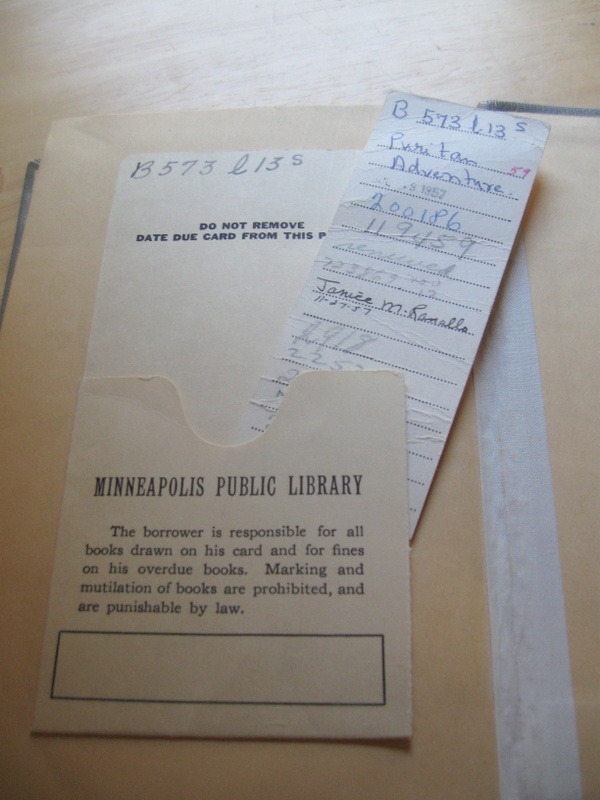
Finally, I just have to say I’m so glad my library keeps old books like these.  I loved this relic of the past in the back of the book:

The dates on this card are from 1957! 🙂

I’m linking up with:


Book Discoveries this Week: Margaret Pumphrey’s Pilgrim Stories September 13, 2012

Filed under: Books,History — kirstenjoyhill @ 10:46 pm
Tags:

As we were wrapping up our unit on Native Americans and Explorers last week, we needed a new read aloud.  We stopped our last one mid-way through due to boredom.  I pulled out a couple of books for our next topic (early settlers/colonists) and a couple non-history-related read-alouds and let Miss M pick.  She picked Margaret Pumphrey’s Pilgrim Stories, revised and expanded by Elvajean Hall.  It’s this edition on amazon.   Apparently there are at least a couple modern revisions/expansions of this 1910 work available.  I can’t compare this edition to the others since I don’t have any of those on hand.

This wasn’t a book that I originally had on my American History book list.   However when I saw it at the Half Price books tent sale for a buck, it was a no-brainer to pick it up.  There is no shortage of books about the pilgrims.  Without much effort, I feel like half our history book basket is about Pilgrims, the Mayflower or the first Thanksgiving.

Margaret Pumphrey’s Pilgrim Stories turned out to be a fine opening for our studies on this topic.  It’s a fairly easy-to-read chapter book with 17 short chapters.  I could have very easily handed it over to Miss M for her to read herself.  But I’m glad I didn’t.  The book opens in 1606 with Queen Anne visiting what turns out to be the home of some of the separatists.  A young girl gives away the secret that her family worships God not in the official church, but in their own meeting.   Soon the separatists are hiding and being even more secretive to avoid capture by the authorities.    Their journey takes them to Holland for several years as they pursue religious freedom (I must have slept through that part of elementary school history class – I didn’t know they went to Holland first!), before they eventually join with many “strangers” to take the journey to the New World.

In Pilgrim Stories we learn not only what the Pilgrim mothers and fathers were doing, but what the children were up to also –some making trouble and getting in the way, others being helpful and brave.  The book follows the story of the Pilgrims through the first Thanksgiving and the arrival of another ship from England (The Fortune) shortly after.

As I put together our reading list for this unit, I noticed that many books leave the story there.  I’ve found a lot of books about Jamestown and Plymouth, and then many more books that pick up the story of life in the colonies in the 1700’s.

We’re filling in the pieces of what life might have been like in New England about 15 years after the first Pilgrims landed in our next read-aloud: Puritan Adventure by Lois Lenski.  I’m sure I’ll be sharing more about that book for a future Book Discoveries post.

I’m linking up with Read-Aloud Thursday @ Hope is the Word!


Book Discoveries this Week: Om-Kas-Toe and Walk the World’s Rim September 6, 2012

Filed under: Books — kirstenjoyhill @ 11:19 pm
Tags:

This week we’re finishing up our first “unit” or topic of our US History studies — Native Americans and Explorers.  We did two read-alouds related to this topic.  Maybe I should really only count it as one-and-a-half since we didn’t actually care for the second one well enough to finish it!

Right before our vacation we read Om-Kas-Toe: Blackfeet Twin Captures an Elkdog by Kenneth Thomasma.    Om-Kas-Toe and his sister Twin Girl are very lucky indeed — while both children are not normally allowed to survive when twins are born, their mother works hard and proves she can take care of both babies.  A series of lucky events seems to follow Om in particular, as he finds a very smart bird that he keeps as a pet and this bird leads him to a number of interesting discoveries.

At the time the story opens, the Blackfeet tribe has not yet been introduced to the horse.  Om and an older member of the tribe see a horse for the first time being led by a member of an unfriendly band of Indians.  This strange animal appeared to be large and powerful like an Elk, yet tame like a dog, hence the name “Elkdog”.   Eventually, Om and his sister are lucky enough to capture their tribe’s first Elkdog.  Om is growing up and proving himself responsible and is given the opportunities for even greater adventures and responsibilities.

The kids and I all really enjoyed this book.  I read this book during the day (as opposed to a bedtime read-aloud with Miss M) since I thought the boys would enjoy it too.  While Mr. K (age 3) got bored and wandered off at times, Mr E (age 5) was riveted — especially when Om or other characters in the story used any weapons.  :-).   After the book was over, he even asked if we could purchase a copy for ourselves so we could read it again some time (our copy came from Interlibrary loan — rare for us since our large library system carries almost everything that we want to read!).

Last week I started Walk the World’s Rim by Betty Baker as a history-related bedtime read-aloud with Miss M.  This story follows a young (fictitious) Native American boy from a poor tribe as he sets off on a journey with (real) Spanish explorer Cabaza de Vaca, two fellow Spaniards and a slave.   The party of travelers is taking a long route to Mexico, where they hope riches, honors and luxury await them.    To be honest, Miss M and I were both bored of this book by about half way through.  I skimmed ahead through the rest of the book and didn’t see much in it I was excited to read about.  I found myself hoping to find some excuse to skip reading it.

Since this wasn’t a classic work or a “must read”, I decided it would be okay to *gasp* just not finish it.  We rarely do this, but I didn’t want to waste our time given the long list of potential read-alouds I have for this year. Miss M seemed a bit relieved when I suggested we had the option to not finish the book!

I’m linking up with Read-Aloud Thursday @ Hope is the Word!


Book Discoveries this Week: Little House on Rocky Ridge series (books 1-3) August 2, 2012

Filed under: Books — kirstenjoyhill @ 8:14 am
Tags:

I really like working on a series of books for read-alouds with Miss M in the summer — especially when I already own the books.  It’s nice to just know what comes next and not have to think too hard or work too hard to find the next book.  🙂  Summer read-aloud time can be more sporadic for us since I read to Miss M right before bed, and there are more times of staying up too late to realistically do too much before-bed reading — so it’s nice not to be relying on timing our reading with books arriving from or needing to return to the library.

For this summer we decided on the “Little House on Rock Ridge” series by Roger Lea MacBride — aka The Rose Years series.  This eight book series features Rose, the daughter of beloved “Little House” characters Laura and Almanzo.

The first book in the series, Little House on Rocky Ridge, opens as the Wilders are leaving drought-ridden South Dakota in search of a better life in Missouri.   After their long horse and wagon journey, they need to find the perfect farm and get settled in before cold weather hits.

Once settled in their new farm, called Rocky Ridge, of course, Little Farm in the Ozarks and In the Land of the Big Red Apple continue the story of the family settling in and trying to develop a prosperous farm.  Rose goes to school, makes friends, learns life lessons (all the stuff you might expect in a “Little House” sort of a book).

Fans of the original “Little House” series will probably enjoy these books as well, though they don’t quite have the same classic quality to me as Laura Ingalls Wilder’s books.  It’s hard for me to put my finger on exactly what it is that makes me feel that way about these books.  I did find it somewhat tiresome that some incidents from the original series are “re-told” in the Rocky Ridge series books in the form of family stories being told to Rose.  While I’m sure this is helpful background to a small number of readers who didn’t read the other series first, I could have done without those passages.

Unlike many of the books in the original Little House series, the early books in the Rock Ridge series take place one right after another with very little elapsed time in between each book — or no elapsed time in the case of books #3 and #4!  We started book #4, On the Other Side of the Hill, just before the Olympics started (completely distracting us from getting any bedtime reading aloud accomplished!) and it starts literally hours after book #3 ends!  Reading the books one right after another also makes it feel odd that the background of some characters or key incidents are re-told in the text of each book.  I suppose this is necessary for readers who may take longer breaks between each book or jump into the series mid-way, but it felt awkward to me.  I can’t remember any moments like that in the original series (but we did take longer breaks between some of those books, so maybe I’m just forgetting about it!).

While I don’t usually go out of my way to plan any activities to go along with our bedtime read-alouds, I couldn’t resist buying a can of hominy after reading about the Wilder family making hominy in Little Farm in the Ozarks.   Everyone in the family liked this not-common-around-here dish.  We also spied a copy of McGuffey’s Third Reader in a gift shop last week — Rose’s class in school reads out of this book in Little Farm in the Ozarks and Land of the Big Red Apple.  It was fun to show Miss M what Rose’s book would have looked like!

Miss M is thoroughly enjoying these books — to the point where I am wondering if she will complain when we get closer to the end of August and I will want to move on to our new “school year” list of read-alouds.   Maybe I’ll just let her take the rest of the books we don’t read before the end of the summer and she can read them on her own (except that I do kind of want to find out what happens to Rose too!).

I’m linking up with Read Aloud Thursday @ Hope is the Word!


V is for Vintage (Books from our shelves) July 26, 2012

Filed under: Books — kirstenjoyhill @ 9:24 am
Tags:

I thought so long on my “V” post for “Blogging through the Alphabet” that I once again missed the appropriate link up.  But luckily since my “V” has to do with books, it still makes a great “Read Aloud Thursday” post.  😉

I have a soft spot for vintage picture books.  The older styles of illustrations from the ’50s through the ’70s really appeal to me, and while many classic books from that time and earlier are still in print and published in neat, shiny paperbacks or hardcovers…there is something even more charming to me about an old-smelling, well-loved copy.

We don’t have a large number of true “vintage” books in our collection, but finally thinking of “vintage” as a good “v” word for the Alphabet blogging link-up, I was inspired to pull two off of our shelves to read them to the boys:

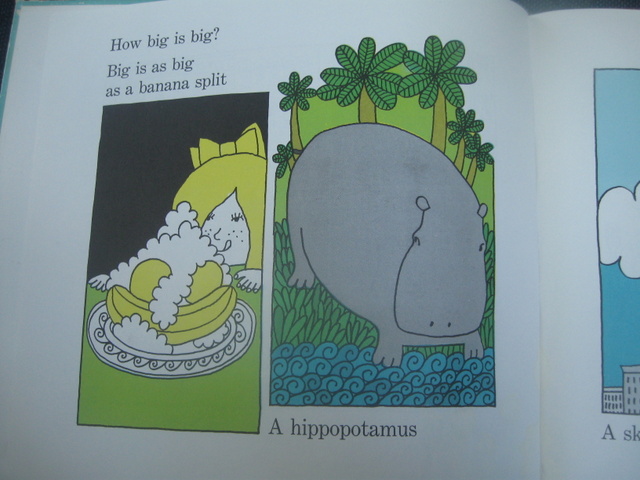
How High Is Up by Bernice Kohn, Illustrated by Jan Pyk is a book a received as a gift when I was a toddler.   It makes me feel slightly old to classify a book from my own childhood as “vintage” — it really is.  It was published in 1971 (I’m not quite that old…but it’s the right decade!), and the illustrations are classic ’60s/’70s style.

I only own three books from my childhood, and this is the only one that I really remember.  It seemed so familiar! When I found this book among my possessions after I had children, it brought to mind tastes and smell and warm fuzzy feelings of childhood.

I would describe this story as peaceful and thoughtful — a great bedtime story.  Questions like “how big is big?” and “how high is up” are answered not with precision but with vivid comparisons.  So how big is big? Big is as big as a banana split (remember how huge those seemed as a child?), A hippopotamus, a skyscraper.

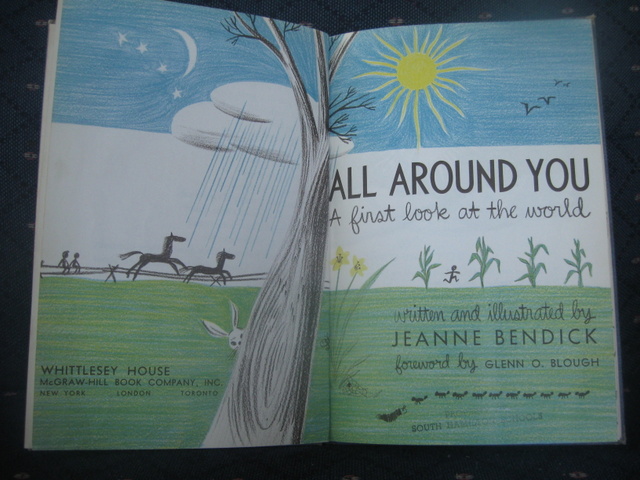
All Around You: A First Look at the World written and illustrated by Jeanne Bendick is a book I got when Miss M was very small in a free box of books.  I don’t recall that I kept very many books from that box, but I think I kept it because of the beautiful pencil/colored pencil  illustrations:

While some “sciency” books from 1951 might be hopelessly out of date, this one luckily sticks to timeless topics like weather, seasons, plants and animals.  It’s a nice preschool or Kindergarten level introduction to these topics.  I could definitely see myself pulling this book out again when the boys are asking about topics of this nature.  I didn’t read the whole book to them this (just the first couple sections), so we have more “saved for later.”

Linking Up to…Read-Aloud Thursday @ Hope is the Word!

Blogging Through the Alphabet