Homeschool Discoveries

Sharing a few things I've discovered along the way…

MACHE Conference 2012 Wrap-Up April 18, 2012

Filed under: Books,Curriculum — kirstenjoyhill @ 8:50 am
Tags: , ,

I had the opportunity to attend the MACHE (Minnesota Association of Christian Home Educators) annual conference in St. Paul last weekend.  It was only my second time attending a homeschool conference, and I am glad I went.

In some ways, my favorite part was the shopping.  I came home with this major purchase:

Yes, it’s an expensive shopping trip to pay money to attend a conference to go and spend more money once you are there.  But on the other hand, it is such a great way to actually see products first hand, ask questions of knowledgeable product reps (or sometimes the authors/creators themselves!), and in some case come home with your item right away.

I’ve known for a couple months that our current spelling curriculum was not working for us.  I had been super curious about “The Logic of English Essentials” curriculum by Denise Eide, ever since having read her book “Uncovering the Logic of English”.   After looking through the material in person, asking questions of the product rep (I was a little bummed that Ms. Eide was not there herself, given that I think she is a resident of our area!), and attending a breakout session about the curriculum I decided to go for it.  I then lugged what felt like a ton of books around for several hours since I didn’t want to pay two bucks for the book check.  Silly, I know!

I’m sure I’ll have a lot more to say about this curriculum in the future, but I will say I decided to jump right in and use it right away, and I think I am going to like it from a teaching perspective.  I guess only time will tell if it will help Miss M’s spelling woes or help Mr. E get off on the right start as a new speller himself.

I feel good about my investment in the sense that even if after a couple months I change my mind, this product should have a good resale value since it is such a new curriculum.

Besides my purchase of the “Logic of English” curriculum, I purchased a few art supplies (using great restraint — I wanted so many more!), a couple handwriting books, and a few fiction books from the used books area.  I even found a copy of “Gentlemen from England” by Maud and Delos Lovelace for myself!

A few other highlights:

  • I attended a seminar on Fractions by RightStart math author Joan Cotter.  It was a helpful seminar, and helped me continue to feel enthused about Right Start.  If games and these concepts can help kindergartners that Ms. Cotter taught learn concepts that upper elementary children often get confused about, this is a great approach.
  • I had a great conversation with a bookstore owner about “spine” texts for American history.  Unfortunately it confirmed what I already thought might be true — I am going to have a hard time finding exactly the type of text I am looking for at this time, given the age of my student and my other criteria.
  • I heard most of a Keynote session about homeschooling as an opportunity to make disciples.  I am challenged to think “simple” when it comes to having devotions with my kids.   While something fancy and prepared is great, we can also have a great time in the Word by just randomly (or purposefully) having a “one inch” Bible study as the speaker called it — picking an inch of text and discussing a few simple questions: What does it say? What does it mean? What does it mean to me? So What should I do about it?

My conference experience was not without its frustrations.  Two seminars I wanted to attend were full by the time I arrived.  I lost my name tag mid-way through the second day and had to pay a $5 fee to get a new one.  Bummer!  But overall it was a great experience.  I’m not sure going to a conference is an every year sort of thing for me, but I definitely enjoyed my time this year.


C is for Cursive March 7, 2012

Filed under: Curriculum — kirstenjoyhill @ 8:07 am
Tags: ,

Miss M asked to start learning cursive last year as a first grader.  Considering that for most of the previous two years she complained about having to write almost anything, this really took me by surprise.  I am one of those adults who never writes in “pure” cursive — I hated cursive penmanship practice in grade school, and my current handwriting is my own blend of printing and cursive (though I think it leans more to the “printing” side of things). I was perfectly willing to let Miss M wait until at least third grade to learn cursive, if not later.

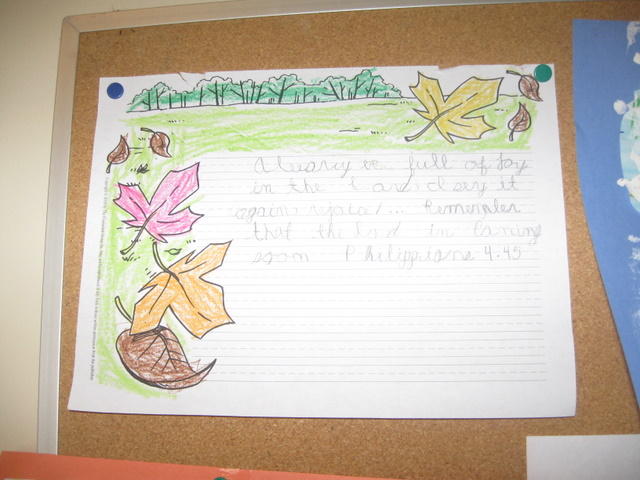
Not wanting to miss this moment of her interest, however, I bought her “A Reason for Handwriting” book C a little over a year ago.  She spent last spring dabbling in learning her cursive letters.  The first section of the book is dedicated to first practicing each individual letter, adding in a few simple words once enough letters are learned.  After a break for the summer, I reviewed with Miss M the letters she had learned the previous spring, and she finished learning the rest of the alphabet.

Then the real fun begins.  🙂 The second section of the book contains 32 weeks of lessons, each featuring a Bible verse. Days 1 through 3 of each week’s lesson contain individual practice words from the verse.  Day 4 is tracing the verse, while Day 5 is writing the verse out on a piece of handwriting paper with a decorative border (the border paper is provided in the back of the workbook). I assign Miss M cursive practice every day, and occasionally I have her “double up” somewhere in days 1 through 3 or skip the tracing day if we don’t have five full/regular school days in a particular week.

While Miss M still usually chooses to print in the rest of her school work, I can really see her cursive improving.  It will be better than mine pretty soon!

I’m linking up with:

Photobucket


A is for Abacus February 27, 2012

Filed under: Curriculum,Weekly Highlights — kirstenjoyhill @ 8:51 am

I love moments like this in homeschooling:

Miss M with our RightStart Abacus

Last Friday, Miss M asked if she could do school in her “prairie girl dress” (and of course the bonnet is a required accessory).  We weren’t doing anything messy, so there was no reason not to wear it. She’s using the abacus here to help her say the multiples of seven.

The abacus is one of my favorite parts of RightStart math.  It helps the student easily visualize what is going on with various math operations.

I’m linking up with…

Caitlin @ Those Wandlings for “You Don’t See That in Public School!

and

Photobucket


How We Picked a Math Curriculum — Part 1 February 21, 2012

Filed under: Curriculum — kirstenjoyhill @ 7:07 am
Tags: ,

When Miss M was about four and a half, I decided I wanted some of kind of curriculum to guide me as she progressed beyond simple counting.  I knew I wanted a program that would keep things fun, and would involve little to no handwriting, since at that time, Miss M struggled to write any numbers at all.  A friend had a copy of Saxon Math K that I was able to take a look at. I saw that this program involved no writing, and had scripted lessons for the parent to follow.  I soon found a used copy, bought a few inexpensive manipulatives, and began progressing through the lessons with Miss M.

The lessons in Saxon Math K are fun, and (in my non-professional opinion), age-appropriate for an older preschooler or younger kindergartener.  We started working on a calendar, we used plastic bears to count, add and make patterns and we reviewed shapes.  But something quickly became clear to me — the way Saxon Math K jumped around from topic to topic drove me crazy!  We would spend a day working on counting, only to have the next lesson focused on shapes, followed by a third lesson on a topic altogether different before returning to a lesson on counting.   I tried to make my own plan for re-arranging the lessons in a way that would involve less jumping around, but it was a lot of work to do so.   After using Saxon for a couple months, I knew that when Miss M started her Kindergarten year I needed to have something else.

As I researched math curricula, I learned that math programs generally either follow a “spiral” philosophy or a “mastery” philosophy.  Some may be more extreme than others in the degree to which they follow these philosophies.   Programs that lean toward the spiral philosophy introduce several topics, then “spiral” back to the first, second and so on to give the student greater depth and more exposure, then the cycle repeats.  Spiral programs have lots of built in review, and keep students from getting bored by varying the topics studied.  Some students, however, may be frustrated by only getting a taste of a topic and not having time to develop a skill before moving on to another topic.

The mastery philosophy is just what it sounds like — mastering one topic before moving on to the next.   Curricula that follow the mastery philosophy will also tend to pursue a topic to greater depth before pursuing a new topic.  For example, instead of moving on to single digit subtraction after single digit addition is mastered, a mastery curriculum is more likely to continue to two, three and four digit addition before introducing subtraction.  At the extreme a mastery curriculum may have the student studying the same general topic like addition or subtraction for an entire level of the curriculum.  Common criticisms of mastery curricula are boredom and lack of review.  Students may get burnt out studying subtraction for months on end, and may forget some of their adding skills in the mean time.

Having learned about these approaches to math education, I knew I would prefer a curriculum that leaned toward the mastery approach.  I didn’t think I would like something on the extreme end of the mastery spectrum, but in general the mastery philosophy made more sense to me.

Having ditched Saxon Math K not long before Miss M was beginning her actual Kindergarten year, I wasn’t quite ready to commit to a particular curriculum that I might be using for years.  As a stop-gap measure, I decided to begin K with Kindermath by Eagles Wings, a program I had recently received along with a phonics and spelling package I had purchased.

Kindermath is nice simple program for Kindergarten students.  It doesn’t have any bells and whistles — just a simple teacher manual and student workbook, both in black and white.  But, this gave me something I could do with Miss M for math.  We used it for the first four months of her K year.  After that, we began RightStart — the program we are still using!  I’ll discuss why we chose Right Start and how it works for our family in part 2 (Now posted — read it here!).

If you are looking for more information on how to chose a math curriculum, this article is a great starting point.  I also highly recommend checking out the wealth of resources (including articles and product reviews) at homeschoolmath.net!

What resources have you found helpful in the process of picking a math curriculum?


(photo credit)


Curriculum Discoveries: Mystery of History January 25, 2012

Filed under: Curriculum — kirstenjoyhill @ 7:24 am
Tags: ,

This will be the first in a series of posts on the curricula we’ve discovered that works for us!

We are currently in our second year of using Mystery of History as the spine for our history studies.  After spending the fall of Miss M’s Kindergarten year reading a fairly boring early elementary history text, I knew I wanted to look for something different.  While I have been intrigued by curricula that put the focus on literature, I really wanted a spine that was interesting enough and informative enough to stand alone if we didn’t get to other readings.  I also was looking for something that would allow for a study of ancient, medieval and potentially some of Renaissance world history at a 1st-2nd grade level.

I decided that Mystery of History (MOH) would be a good fit for us, because it fits those criteria, and has the added bonus of coming from a Bible-believing Christian perspective. MOH can give a very good introduction to world history just through reading the text.   This curriculum can really hit at any ability level (or time availability level!), with timeline suggestions, quizzes, suggested activities for each lesson for three different age groups, and suggestions of additional reading, videos or websites for nearly every lesson.

Miss M and I studied Volume 1 of MOH last year — Creation to Christ.  While we diligently kept up a timeline for most of the year, we gave it up about 3/4 of the way through, when our printer started having trouble with the thick paper I had chosen for the timeline.  I still have a bunch of colored in timeline figures floating around in my house somewhere that never got glued on to anything. Lame, I know.   We didn’t do very many extra readings or suggested activities, but Miss M seemed to enjoy most of the chapters of the text, often asking me to read “another chapter, please?!?!”.    The author, Linda Hobar, does a great job of making history interesting and relating it to a Christian perspective.

Having made a projected history/geography schedule for the upcoming years for our family, I decided I wanted to do American History when Miss M is in 3rd and 4th grade.  So, what to do with 2nd grade?  I decided we would go through all of MOH volume 2 (Early church through the Middle ages) and part of MOH volume 3 (The Renaissance), aiming to get up to the point in Vol. 3 where most American History curricula would pick up time-wise.

We started MOH 2 last July, reading 4 lessons per week through the 1st quarter of the book, then dropping down to 3 lessons per week to allow for more supplemental reading once we reached the Dark Ages/Middle Ages.   Why the different paces? Honestly, because I love the Middle Ages (my favorite time period in history!). I decided not to even try a timeline this year — Miss M doesn’t seem to miss it, and we’ll try a timeline again when we study these time periods when she is older.

We’re on track to finish Volume 2 in mid-February.  We’ll read 3 chapters per week of Volume 3 through May, and then most likely take a break from history for the summer.  I’m still undecided about what materials we’ll use in our study of American history next fall.

Mystery of History is a great curriculum choice for families looking for world history from a Christian perspective. It can fit with the classical model of a four year history cycle (though the 4th volume is still in development), or it can be used flexibly with longer or shorter history cycles.

If you decide to use Mystery of History for your history studies, here are some resources to check out:

Mystery of History Yahoo Groups for Vol 1, Vol. 2, and Vol 3. (Great discussion and lots of resources in the files to help with timelines and lesson planning)

I made a planning chart for our studies this year, including supplemental readings and listening (we didn’t quite do all of what I planned so far, in case you were wondering).  Get the file at Google Docs.   I’ll be adding planned readings for Volume 3 sometime in the next couple weeks.

I also made a list at World Cat of some of the supplemental books I planned for this year (again, we did end up skipping a few of these).  Again, I haven’t added books corresponding to Volume 3 yet.  If you aren’t familiar with WorldCat it is a resource well worth checking out — WorldCat searches for books in libraries around the nation.  Set a favorite library, and you will quickly be able see if your local library holds a particular item, or if you will be able to get it from a nearby library using InterLibrary Loan.