Homeschool Discoveries

Sharing a few things I've discovered along the way…

Book Discoveries this Week: The Friendship Doll and The Cricket in Times Square June 7, 2012

Filed under: Books — kirstenjoyhill @ 11:13 pm
Tags:

Today Miss M and I did something we haven’t done in a long time – we actually had extensive read-aloud time during the day instead of just at bedtime! With the slower pace of summer (and the boys otherwise occupied playing), we hung out on the couch and read.  Then we moved our reading outside to a blanket under a tree while baby J enjoyed playing with his toys on the blanket with us.  When Mr. K was a baby (and Miss M was not yet reading chapter books on her own), Miss M and I would spend what seemed like hours reading almost every afternoon.  Maybe I should get a “patience” award for the fact that I read her dozens of the “Rainbow Magic” fairy books that she just loved during that year.  😉

Luckily Miss M’s taste for read-alouds has improved drastically in the past two or three years.  Today we were finishing up The Cricket in Times Square” by George Selden.  This was a relatively straight-forward read that Miss M could have accomplished on her own, but since I had never read it, I decided to select it as a read aloud.  The chapters are short and had our schedule been typical over the past two weeks, I think we would have finished it quickly.  But our life has been consumed by busy weekends and evening swimming lessons the past two weeks, very much disrupting our usual bedtime schedules.

In The Cricket in Times Square, Chester Cricket accidentally makes his way from Connecticut to New York City trapped in a picnic basket.  He finds himself in the Times Square subway station, and becomes the pet of a young boy named Mario, and a friend of a mouse and a cat.  Chester turns out to be no ordinary cricket — he has musical talent and uses it to bring joy to those around him.   This was a pretty straightforward story of friendship and finding out what truly makes one happy.

Miss M asked if this book was one of a series, and I replied that no, I didn’t think it was.  However a quick search on Amazon just informed me otherwise! Selden wrote a few other books about Chester and his friends! I think I’ll be reserving those for Miss M at our library.

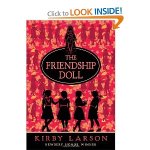
Prior to finishing The Cricket in Times Square, we read The Friendship Doll by Kirby Larson.  I was just too busy packing for a camping trip to write about it last week.  🙂 Another book in the “dolls that have a life of their own” sub-genre, this story features Miss Kanagawa,  a rather large handmade doll from Japan that is sent to America with a whole group of Japanese dolls to serve as ambassadors of goodwill in the late 1920s.  The Friendship Doll alternates from a 3rd person narrator’s point of view, telling the story of four different girls who come in contact with Miss Kanagawa over the years, and a first person point of view of Miss Kanagawa relating her experiences.  Miss Kanagawa doesn’t quite have the charm or grand historical scope of Hitty (a favorite of ours from this sub-genre this year), but it has a lot of depth.

Bunny, the first girl in the story to cross paths with Miss Kanagawa is a bit of a spoiled brat who learns a lesson about friendship and stepping into the shoes of others in the late 1920s.  The following three girls are in a bit more desperate situations.  These three girls all live during the Great Depression.  Themes of economic hardship, poverty, discrimination, sickness and death are all touched upon as Miss Kanagawa influences the lives of three girls in three very different situations.  For a while in the middle of The Friendship Doll, I was beginning to think that the subjects were getting too heavy for me to really enjoy this book.  I must admit that at this stage of life I am really preferring books that are a bit more “light and happy” in general.  But I pushed on through my doubts and was finding myself moved by Miss Kanagawa and the lives she touches.

Miss M didn’t seem bothered by the heavy themes in this book, though I am glad we didn’t read it any sooner in the school year than we did.  She was excited to hear about each of the girls in the story, though she wished that more of the story had been told from the doll’s vantage point (the sections written in the doll’s “voice” are really a pretty minor percentage of the book as a whole).

Finishing The Cricket in Times Square marked the completion of our 25th read-aloud for this school year!  We’ll be taking a bit of a different turn with our read-alouds this summer by working on a series together.  (I was going to make that change after Friendship Doll since we completed that at about the same time as our actual school year, but I just couldn’t resist making it 25!).  This summer Miss M and I are going to start the “Rose” series of Little House books that follows the life of the daughter of Laura Ingalls Wilder.  We’ll read those until we finish the series, the fall arrives or we get bored of it I guess…whichever comes first!

I’m linking up with Read-Aloud Thursday @ Hope is the Word!


Initial Impressions of “The Logic of English Essentials” Curriculum

Filed under: Curriculum — kirstenjoyhill @ 10:15 am
Tags: ,

At our state homeschooling convention this past April, I made a big investment: I purchased the Logic of English Essentials curriculum and some of its supporting products.  We didn’t have very many weeks to use it before we hit our six week summer break but, it made a big impression on Miss M. When asked about her favorite thing that happened during 2nd grade, she said “finding a new spelling curriculum!”  I was pretty shocked to hear her say this. After all, we did a lot of great stuff this year!  I have to agree though that stumbling across Logic of English is something I’m pretty happy about from this year too.

Our Past Spelling Experiences

Before I get into my impressions of the Essentials curriculum, here’s a little background on what led me to the decision to buy it.  Our first experience with a spelling curriculum came along for the ride with the phonics package I wanted to use with Miss M.  After a few missteps and a bit of experimentation, we hit upon a method of reading/phonics instruction that worked well for Miss M.  We used the curriculum Alphabet Island, which teaches phonics by turning the alphabet into some clever characters.   It then uses a variety of songs and stories to teach various phonics rules and concepts.  This was my first exposure to any type of phonics or spelling rule beyond “i before e except after c” and a few simple statements of that ilk.  I had no idea that there was any sort of pattern, for instance to when “c” or “g” said their hard or soft sounds.

Alphabet Island level 1 got Miss M through reading and spelling three-letter cvc words in Kindergarten.  Then level 2A helped Miss M in first grade to improve her phonics skills to a bit more complex level and start reading and spelling a few varieties of words four letters and longer.  A couple months into first grade, Miss M’s reading ability suddenly took off.  I don’t know exactly how this worked out, but in a matter of weeks she went from solidly sounding out a variety of four letter words, to reading easier chapter books with ease.   We didn’t really need Alphabet Island for learning phonics any longer, but it quickly became clear that Miss M could not spell many, many of the word she could read.

We pressed on through Level 2A of Alphabet Island and started level 2B.  Miss M did weekly spelling lists and filled out workbook pages.  I loved the clever way it presented various spelling rules.  But it wasn’t sticking.  Words that Miss M knew one week were gone the next.  Words correct on a spelling test would be incorrect everywhere else. She didn’t know when to apply which rule.

One thing Alphabet Island does not emphasize is the teaching of all the sounds each phonogram makes.  After a bit of reading and research, I thought a program that teaches phonograms might help Miss M to make improvements.  Being the generally budget-conscious person that I am, I decided to try out “How to Teach Spelling” (HTTS) and it’s companion workbooks. It’s one of several curricula based on the Orton-Gillingham approach to spelling and phonics.

We tried out HTTS for the first few months of this past year (Miss M’s 2nd grade year).  I really can’t fault this curriculum much at all in terms of its underlying principles.   How to Teach Spelling has many of the same underlying principles as Logic of English!  However, it is not particularly user friendly.  I could ask Miss M to fill out workbook pages, but then I had to skip around to various portions of a teacher manual and use some guesswork to figure out exactly which portions I was supposed to use when to somehow teach the rest of a lesson.  The authors recommend teaching all the phonograms and their sounds, but I was on my own to make flash cards or find other ways to accomplish this task.  So, in other words, we really didn’t practice the phonograms much at all.  I didn’t have the time or energy to figure all that out on my own.

After Christmas I pretty much abandoned How to Teach Spelling in favor of just trying to teach Miss M the words she herself was misspelling.  She completed exercises in a writing workbook, and then I would correct her spelling and make lists of oft-misspelled words.  She practiced these words on scratch paper or on the iPad.  But still her spelling was not improving.  She was still spelling the same words wrong over and over again and misapplying the rules she did know.

Enter “The Logic of English”!

Earlier this year, I read Denise Eide’s book, Uncovering The Logic of English.  You can read my thoughts on it in this post, but needless to say it made a big impression on me.   The more I learned about teaching reading and spelling by teaching the phonograms and a few simple spelling rules, the more I wanted to really do a good job of teaching spelling in this way.

And based on my experiences with How to Teach Spelling, I knew I needed a curriculum that would “hold my hand” and tell me what to do each day to make it happen.  Life is just busy around here and while I can fly by the seat of my pants or do my own planning for some subjects, spelling just isn’t one of them.

Using Logic of English Essentials
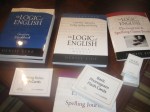
I started using the Logic of English Essentials as soon as I brought it home from the convention.  After reviewing the teacher manual, I decided we would try and work through the curriculum at the curriculum at the pace of 1 lesson per week with Miss M (finishing 2nd grade, and moving into 3rd grade next year), while simultaneously teaching Mr. E (age 5, just starting Kindergarten) the phonograms.  The Logic of English Essentials teacher’s manual offers a variety of suggested schedules — from an intense remedial schedule that could be completed in a couple of months to a multi-year schedule for younger learners.

I’ve already been teaching Mr. E to read using Phonics Pathways as well as a variety of phonics-based easy readers.  That method is working well for him, so we’ll continue that while incorporating information from Logic of English.  We discuss spelling in informal ways currently, and my gut feeling is that spelling will come more easily to him than it has to Miss M.  I’ll start moving through the spelling lessons with Mr. E once he is reading a bit better and is more comfortable writing in something other than just all upper case printing.  That may be right away this fall, or it may be later — I’m not quite sure yet.

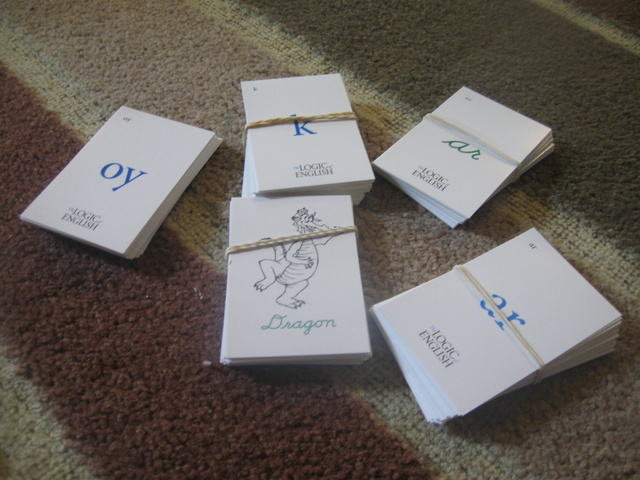
The format of the lessons in the Logic of English Essentials teacher’s manual makes it easy for the parent to pick up the manual and use it without a lot of prior preparation.  Each lesson tells you what to say if you need exact prompts, tells you what materials to use and which activities or workbook pages to complete.  The lesson is divided into several parts, making it easy to spread the lesson out over a week or more and still know what to do each day. The only prior preparation that may be necessary is sorting through the phonogram flash cards (and game cards if you are going to use any) to find the new sounds you want to add to your “deck.”  The first week I didn’t do this ahead of time, and I had some frustrated students on my hands while I looked through a big stack of cards and decided what we needed.

Each lesson generally seems to follow the same basic format, so even after just three lessons (aka three weeks of use), Miss M seemed very comfortable with the process and knew just what to expect.  Each lesson has several “optional” exercises as well as the main exercises if students need more practice in certain areas.  Grammar and Vocabulary development activities are included, but you can omit those if you prefer or spend less time on them.  With the grammar in particular, we will be just lightly covering this material as I have plans for more in-depth grammar study once Miss M reaches 4th grade.

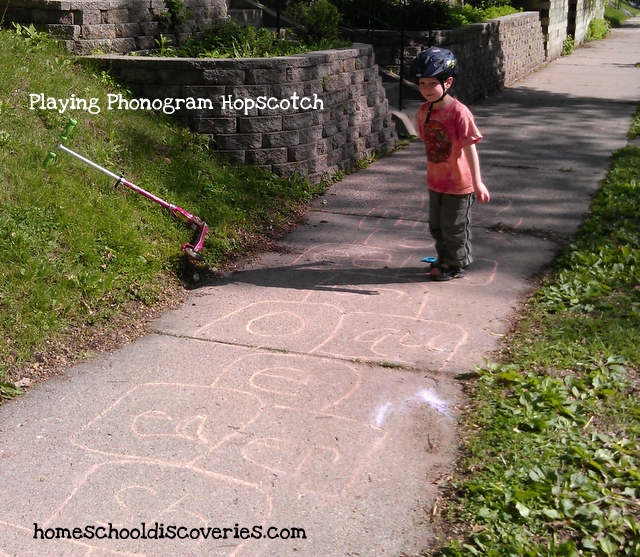
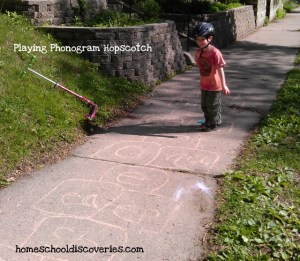
I bought the optional, but very useful, Phonogram and Spelling Game Book as well.  Not every lesson incorporates games, but if you have a younger learner or a learner who finds games to be a very useful method of study having the game book will be very useful in finding additional ways to practice.  The book features card games, paper games (like bingo), games that could be played with a chalk/dry erase board and active games for learning while playing something like hopscotch.  I like the fact that the games can easily be tailored to multiple ability levels.  I expect Miss M to know all the sounds a phonogram makes, I allow Mr. E some leeway to remember “most” of the sounds (as a five-year-old it is taking him a bit longer to remember all the sounds for some of the phonograms that have three or four sounds!) and I can even include Mr. K at times as he is beginning to learn the names of letters and perhaps one sound that each letter makes.

Q and A about Logic of English Essentials

I’ve been gushing to friends about our new spelling curriculum, and they have asked some good questions.  I’m guessing that other people may be wondering about some of the same things:

Is it worth the money?

This is a big question on many people’s minds! Logic of English is more expensive than some “basic” spelling programs.   The teacher’s manual and one workbook without any extras runs $120.  However most of those “basic” spelling programs either require more teacher prep/decision making (as I discovered with How to Teach Spelling) OR they are not phonogram/rule based.  If you have a student who needs direct instruction in spelling (aka they aren’t just a really natural speller) and you want the benefits of a rule/phonogram based spelling program and you want the prep-work done for you, then clearly this is worth your money.

If you have a student who seems to excel with weekly spelling lists or just remembers easily how to spell words, then this whole program might not be worth the money.  However, I believe that everyone could benefit from the basic principles outlined in “Uncovering the Logic of English”, so you could just consider purchasing Denise Eide’s book and teaching your student some of those rules and principles to give them the “why” behind the words they already know how to spell.

Also, keep in mind you are getting big, high quality books for your $120.  The teacher’s manual is a large, sturdy, hardcover book. It should hold up well over use for multiple students and I would guess retain its resale value well because it won’t be falling apart.  The student workbook is definitely consumable, but again, you are getting a big book for your $25.    You might be able to just use a notebook instead or have students write their work on a dry-erase board, but I have seen much smaller/thinner workbooks sold for a similar price!

Purchases of the supporting materials for this curriculum do add up a bit as well (phonogram cards, rule cards, game cards, etc).  Other than the Game book, many of the other “extras” could be made yourself if you have time on your hands.  If time is on your side, go for it.  But if you are limited on time as I am with four kids, then it seems very worth while to just have all the phonogram cards and so on ready to go!

How much time do you need to spend each day on spelling? Can the student work independently?

The amount of time spent will depend on the schedule selected.  If you want to go with the fast-paced remedial learner schedule, Eide recommends as much as an hour or two per day.  For the schedule we are following, 30 to 60 minutes per day is recommended.   I find that we are spending about 30 minutes per day, unless we are playing a game that takes longer to complete.  A portion of the lesson (mainly workbook practice) can be done independently but the parent will be spending a majority of the lesson time with the student.  Time spent with younger students will vary depending on their patience and readiness.   Mr. E’s patience so far for practicing phonograms or playing games is rarely longer than 15 minutes or so.  That’s fine, since I don’t expect a five year old to move through the material very quickly.

Have you found any similar programs? Who would or wouldn’t like Logic of English?

The program I most often see Logic of English compared to is All About Spelling.  Both programs have a lot of the same underpinnings, but teach the material differently.  All About Spelling is divided into more levels that are individually less than the cost of this program, but purchases of those levels will quickly add up as well.  I have not used All About Spelling so I can’t really fairly compare the two.  If you are looking for a rules/phonogram based spelling program, however, that is probably the other program you would want to check out.  As you read about both, you can find out which program’s approach and teachings methods appeal more to you and your students.

If you are looking for a program with a limited amount of writing, then Logic of English Essentials might not be the program for you, though you could conceivably do many of the exercises in modified ways if you have a student that struggles with writing.

If you don’t like having lots of pieces and parts to keep track of, then you might find the “games” aspect of this program annoying — but the program should work without the games, so don’t let that alone keep you from checking out this program.

It’s also not a program that can be completed independently, as I mentioned earlier.  You need to make sure that you as the parent have the time to spend teaching your student.

How well do you think this would work as a stand-alone curriculum to teach a younger student (Preschool or Kindergarten) how to read and spell?
Logic of English essentials does have a schedule for younger students to complete the program over the course of two years.  I think using the program with younger students is not quite as “open and go” as it is for a bit older students who already know how to read and have the maturity to sit and complete 30 minutes of spelling work.  First, you would need to make sure your younger student can recognize, know the sounds of, and probably also write the letters A to Z in lower case. Students also need a basic level of phonemic awareness (activities are included, but not extensively scheduled out). You would then have to decide how to break up the parts of each lesson into smaller chunks and when to add additional games.

Since Logic of English is primarily a spelling curriculum, you would at minimum need to add plenty of phonics-based readers for practicing blending words together.  LOE Essentials moves in one lesson from mostly three letter words to four and five letter words.  Based on my limited experience, most beginning readers need lots of practice at the CVC or  “three letter word” blending phase, and additional practice for consonant blends, and so on. While the building blocks (the phonograms and rules) are presented, you would be “on your own” to practice these concepts.

I have a suspicion that most parents would be happier using some other curriculum prior to or along side of Logic of English Essentials for teaching a younger student to read.  I would suggest checking out Phonics Pathways or The Ordinary Parent’s Guide to Teaching Reading, as these programs will provide more step-by-step reading practice.

Have any other questions? I will try and answer them in the comments, or check out the Logic of English website, including their forums!


P.S. (Added May 12, 2013):  We’ve now been using Logic of English Essentials for over a year! Read my one-year-later update here.

 

O is for Organizing June 6, 2012

Filed under: Getting Organized — kirstenjoyhill @ 9:07 am

We’re currently on a six week summer break from most of our formal academic work.  And wow, it has been hard to get in the mindset to think about anything homeschool-related at all, whether it be for this blog or for planning and getting organized for next year!   But I also know that now (when we are on break, and really all summer long until we get back to a “full” school schedule) is the time to get all my ducks in a row for a great start to the next school year!

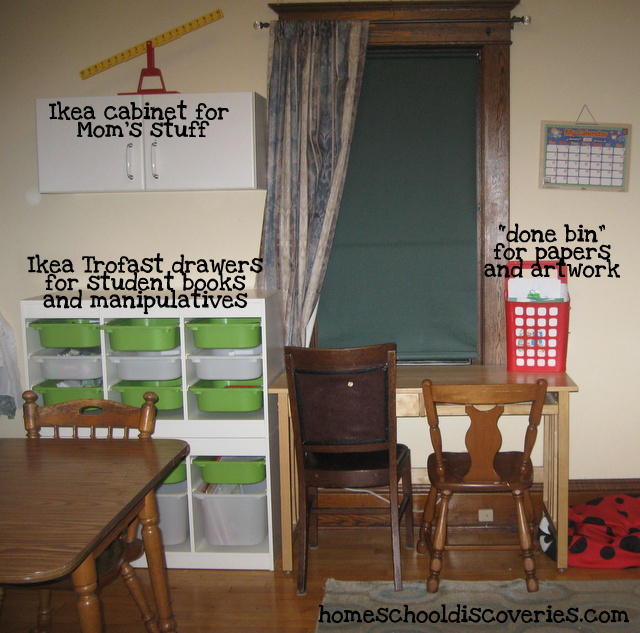
The past few summers I’ve had to spend major time organizing our school room/supplies.  This year, we are still fresh from a big re-do of our school room back in January:

I only wish it still looked that clean! (The only down side I’ve found so far to the Trofast drawer set up is that big, flat open space…it’s a clutter magnet!).    The main thing I need to do is clear out this past year’s stuff and possibly make some labels so everyone knows whose stuff is where! Our art and game cabinets need a bit of “touch up” organizing — but they are still pretty fresh from our big January clean-out as well.

I do have two other areas that need my organizing attention this summer: Our non-fiction kids books and my electronic files.  I tried to get some of our non-fiction books organized into Ikea magazine holders last summer.  But I never got the magazine holders labeled, and the result was those books didn’t get used very much.  I need to move out of the way some history books we probably won’t use this year to make more space, and find a better system (or maybe just labels on the old system) for the rest of the non-fiction books.

My electronic files need the most organization of all.   You know all those great free PDF-format printables and Ebooks?  Or those $1 sale files from the Scholastic teachers express store? Or the great deals that currclick offers? I must have dozens of those files, spread out between two computers, my iPad and even still sitting on Currclick and Scholastic’s servers, having never been downloaded.  A few files are nicely in a big folder labled “homeschooling” and some are just in the general “downloads” folder along with every other random thing we’ve downloaded in the last couple years.   I’m not making good use of the files I have, and I have nearly re-purchased a file for a second time that I had already paid for once (because it looked just as good the second time!).

So one of my challenges to myself this summer is to take care of this organizational disaster.  I think I need to condense everything to one place, possibly with file folders labeled by subject area and maybe even a master list of files I have purchased.   And now that I’ve told the world I’m going to do it, I’ll need to follow through and actually do it! 😉

To see what other bloggers are writing about for the letter O, visit “Blogging through the Alphabet” at Ben and Me!

Photobucket


Summer Reading May 30, 2012

Filed under: Books — kirstenjoyhill @ 10:00 pm

Ah, the lazy days of summer…well, as “lazy” as they can be with four young kids involved! Today we enjoyed the second “regular” day of our six week summer break from regular academics —  a.k.a. a day that would have been a school day had we not already started our break!

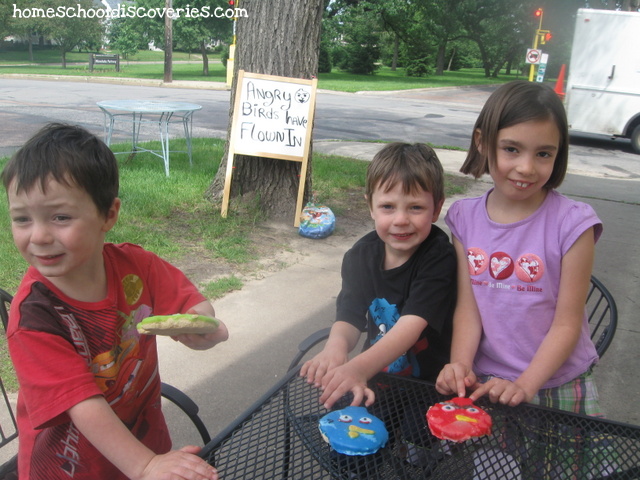
Reading books is still very much a part of our day, however.  Mr. E is eager to keep progressing in his reading skills.   I gave him the challenge last week to read all 10 books in the Now I’m Reading Level 2 set “Amazing Animals” by Nora Gaydos in order to “earn” a trip to a neighborhood bakery for an Angry Birds cookie.  He read the last four books today!

Even though they were overpriced (so much so that the clerk kept apologizing for how expensive they were!), I bought one for each kid as a fun celebration of a reading goal accomplished.

Our local library does not offer much in the way of summer reading programs — they have volunteers doing fun crafts with kids on many summer days, but no prizes for accomplishing reading goals like some libraries have.  We’ll participate in a couple of book-store sponsored summer reading programs that involve the kids tracking the number of books or number of minutes they read each day.

For Miss M I created a “Genre Challenge” inspired by a similar challenge printable at Walking By the Way.  We haven’t decided on a reward yet, but her challenge is to read a dozen books each with a different genre or characteristic, many of which are not things she would select on her own (such as a non-fiction book about a science topic or a fiction book with a male main character).   I’ll also have Miss M keep a reading log for the first time of all the books she reads.  That’s a habit I want her to start doing all the time, not just this summer!  Just since Friday afternoon when I declared the beginning of summer break, I think she has read at least eight books!

Besides the bookstore reading reward programs, I may set up a few more mini-challenges for Mr. E similar to the challenge that earned him the Angry Bird cookie.  He is pretty motivated to practice reading, but I know that these early weeks or months of needing lots of practice, practice, practice can get tiring…so a few extra motivators certainly won’t hurt.

I’m diving into a reading challenge of my own (inspired by this blog post), though it may be a true challenge to complete it.  I started a Bible-in-90-days reading plan in my YouVersion app on the iPad.  With about 100 days from the day before Memorial Day to Labor Day, that would give me 10 potential catch-up days.  Even with that, I’m not sure it will be very easy to find the time to really read something like 16 chapters a day.  But given that I had gotten into the bad habit of reading a chapter or two a day to the kids and not reading any further on my own, even keeping up partially with this kind of reading plan is an improvement.  As much fun as it would be to read facebook and light novels while I “supervise” the kids in the bathtub-depth backyard pool, I know doing some extra Bible reading first will be a good thing for my spiritual life.


Collage Friday: Traveling, Celebrating, Finishing Up May 25, 2012

Filed under: Weekly Highlights — kirstenjoyhill @ 9:32 pm

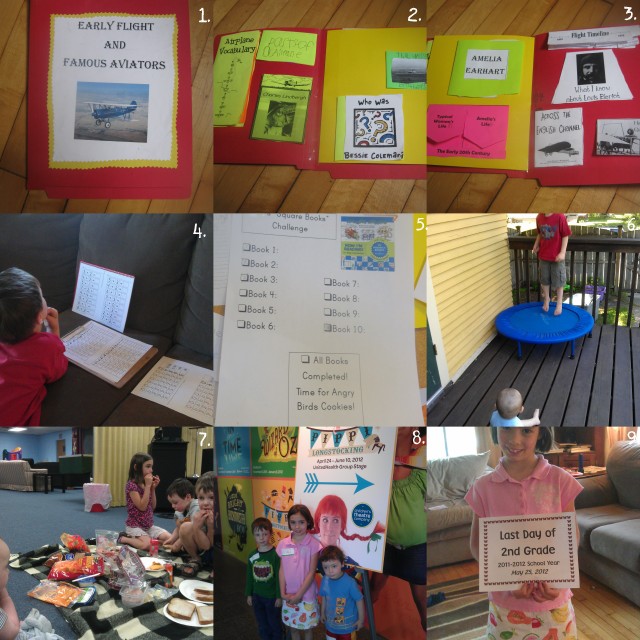
It’s been a whirlwind of a week for us as we traveled to visit family, celebrated Miss M’s 8th birthday and declared ourselves finished with the 2011-2012 school year.  With nearly 120 pictures in my folder for the past week, it takes three collages to fit it all in.  🙂  First, the special trip and Miss M’s special day:

The kids love going to Grandma’s house (Tony’s mom) and experiencing the wide open space of the Iowa countryside.  The kids played with their cousins, we celebrated a family graduation and Miss M’s birthday.  She is super excited to have her own tennis racket!

Then right on the heels of the trip, we celebrated Miss M’s birthday on Monday:

Miss M wanted a field trip day for her birthday, so after birthday donuts and pastries for breakfast (our family tradition) and a “reveal” of her birthday present (a small trampoline) we headed for a day at the Minnesota Zoo!  We ate Miss M’s birthday dinner of choice and had a fruit tart/pizza for dessert! What a fun day for a wonderful 8 year old!

Here are a few more highlights from the other four days of our week:

1-3: Miss M finished her Early Flight/Famous Aviators lapbook.  This was her primary schoolwork this week. I really wanted her to finish this up before our summer break, because I was pretty sure that if we didn’t get it done this week it might not get done at all!

4-5: Mr. E did at little bit of math at his request, and started a new “reading challenge.”   Mr. E recently saw a sign at a bakery advertising “Angry Birds” Cookies (and we know this boy loves Angry Birds!). I told Mr. E that if he completed a reading goal we decided on together, we could all go to the bakery for cookies.  We decided that he would read all 10 books in the “Now I’m Reading” Level 2 set “Amazing Animals” by Nora Gaydos.   He’s already finished four books from the set!

6.  We discovered Miss M’s new trampoline has a nice side benefit.   Have a crabby baby? Just set him in a spot on the deck to watch the other kids taking turns jumping on the trampoline.  No more crabby baby!

7. We had our last co-op meeting of the year on Thursday morning.  We were supposed to head to the park for a big picnic after co-op…but we got rained out and had an indoor picnic instead.  After the picnic, we met up with my mom for a brief belated celebration of Miss M’s birthday (one of her gifts from Grandma Karen was her very own sewing box!) and a new summer haircut! (Check out the 4 inch difference in length in Miss M’s hair in the earlier pictures to pictures 8 and 9!).

8. We went to see a musical performance of Pippi Longstocking at the children’s theater on Friday morning.  We’ve been looking foward to this for months, and it was indeed a great show!

9. Today (Friday) was our “official” last day of school before a six week summer break.  We’ll start adding subjects back in after the 4th of July.  We celebrated the end of the school year with a family ice cream outing tonight.  Tony asked the kids what their highlights were from this school year.  Mr. K said, “seeing People Longstocking” (as he was calling it all day long).  Mr. E said “learning to read!”  and Miss M said, “Finding a new spelling curriculum.”  (That really surprised me!).

I’m looking forward to a three day weekend filled with projects around the house, BBQs and 50% off sales at the local thrift stores! Enjoy your holiday weekend!

I’m linking up with Collage Friday @ Homegrown Learners and the Weekly Wrap Up at Weird, Unsocialized Homeschoolers!

PhotobucketWeird Unsocialized Homeschoolers


Book Discoveries This Week: Books about Early Aviators May 24, 2012

Filed under: Books — kirstenjoyhill @ 5:24 am
Tags:

We’re just finishing up a delight-directed unit study on the history of flight and famous early aviators.  The kids’ interest in this topic was sparked by watching a PBS/Nova video on Netflix streaming about the Wright Brothers.   Miss M wanted to focus primarily on the lives of famous pilots (rather than learning about the planes themselves), so most of our book choices were biographies. I’ll highlight three we particularly enjoyed — two about Amelia Earhart and one about Louis Berliot.

You Can’t Do that Amelia is an easy picture book biography that I read aloud to the boys (several times, at their request!), and Miss M read alone.  This book gives brief snapshots of Amelia at various points in her life — from a young girl who wanted to build her very own “roller coaster” to a woman who wanted to fly alone across the Atlantic.  Many people said, “You can’t do that, Amelia!”.  But she always proved them wrong.   This book stops short of her famous last flight, and doesn’t mention her mysterious disappearance, so it’s a good choice for a younger or more sensitive audiences.

Amelia Earhart: The Legend of the Lost Aviator is also a picture book biography told in story format, but in much greater depth than You Can’t Do That Amelia.  I read this aloud to Miss M, and the boys listened in at some points.  Legend of the Lost Aviator goes into more detail about Amelia’s life in an engaging way.  I felt like it treated the instabilities in her family life (including her parent’s divorce) in a tactful way.  This biography covers many of the major events in Amelia Earhart’s life, all the way through her disappearance and efforts.

The Glorious Flight is another picture book biography that all three kids enjoyed.  This was my first introduction to Louis Berliot, the first person to fly across the English Channel.  Berliot had many unsuccessful attempts before finally creating a plane capable of flying the channel.  The Glorious Flight has beautiful illustrations (It won a Caldecott Medal) to show his various aircraft.   This book is a Five in a Row book selection, and I borrowed the appropriate volume of Five in a Row from  a friend with the idea of using it as a jumping off point for more in-depth study of this book with the boys.  It didn’t work out that way, but I did appreciate reading the ideas in the Five in a Row handbook for discussion and observation points as I read the book to the kids.   I am happy that I bought a copy of this book for our permanent collection!

Here are a few more titles we read as a part of our study:

  • How Airplanes Work – an easy to understand intro to the subject.  The boys liked it!
  • DK Flight – Lots of pictures and details on planes through the years.  We used it for browsing.
  • Charles Lindbergh (Compass Point Books) – A straightforward, factual-style biography that Miss M read on her own.  I think with a bit of searching we could have found a more interesting yet age appropriate book on Lindbergh.
  • Brave Harriet – An easy, picture book style biography of Harriet Quimby, the first American woman to hold a pilot’s license and the first woman to fly the English Channel.
  • Fly High — Picture book style biography of Bessie Coleman, the first African American woman pilot.
  • To Fly: The Story of the Wright Brothers – Fairly in-depth picture book style biography of the Wright Brothers
  • The Wright Brothers: A Flying Start – an even more in depth, factual style biography of the Wright Brothers.  Miss M skimmed portions of this one but didn’t read the whole thing.

I got into the spirit of learning about early aviators with a book selection of my own.  While browsing for books for the kids, I noticed that The Big Jump: Lindbergh and the Great Atlantic Air Race was available for library checkout in Kindle format.  I learned so much in reading this very interesting book.  I previously had the vague impression that Lindbergh was the first person to fly the Atlantic.  He was actually the first person to fly the Atlantic solo and the first person to fly from New York to Paris.  Other daring aviators made the jump on shorter routes before he made his Big Jump.  The Big Jump chronicles the daring early aviators (many of whom lost their lives) who made it their quest to fly the Atlantic as well as discussing Lindbergh’s flight in-depth.

The kids have let me know that they are feeling “done” with learning about this topic at least for the moment.  I was a bit bummed — so many more interesting books we never had time to read or even look for at the library!  The timing works out well though since we are changing gears with our schedule after this week and taking a six week break from most of our studies.   Our library basket and shelves are full of other topics now…but I may have sneaked in a book about Zeppelins in our library bag anyhow.  😉

I’m linking up with Read Aloud Thursday @ Hope is the Word!


N is for Next Year May 23, 2012

Filed under: Curriculum — kirstenjoyhill @ 8:24 am

We’re finishing up our current school year….so it’s the perfect time to think about next year, right? Next year I’ll have a third grader (Miss M), a Kindergartener (Mr E, who will be working above that level in many areas), and a young preschooler (Mr K will be 3.5 at the start of the new school year).  And of course baby J will still be the baby of the family (though he will be more like a toddler by the time I am writing next year’s next year post!).  🙂

Some of my curriculum decisions were very easy, as we are continuing right on from where we are now:

For math we use Right Start.  Miss M completed a little over 100 lessons in level C during her 2nd grade year.  We’ll pick up Level C right where we left off, and then move on to Level D.  Mr E seems like a natural at math.  We’ve informally used level A this year.  I am currently planning on starting Mr E with Level B (also a starting point for Right Start Math), and seeing how that works out for him.  If you want to read more thoughts on why we like RightStart, check out this post.

For spelling (as well as some grammar/composition), we will be using the Logic of English Essentials curriculum.  This is not exactly a continuation, since we’ve only been using it since mid-April.  But once I bought it, I just couldn’t wait to try it out! We’ve done a few formal lessons, and will continue to learn/review the phonograms and play games during our six week break.   This is a new curriculum, and judging from the search terms people are using to find my blog,  readers want to know more about it!  I’m hoping to post a review with a few more detailed (albeit initial) thoughts within the next week or two.  Miss M will be using this curriculum fully, and I will be including Mr. E as best as I can.  He will not be able to move as quickly as Miss M, so it might be a challenge to use it to its full potential with him this year.

I don’t plan on doing any other formal grammar or composition/writing curricula with Miss M this year.  My plan is to begin more detailed grammar study in 4th grade.   Since Miss M findings writing to be very frustrating due to her difficulties with spelling, the composition exercises in LOE  as well as copywork and incidental writing for history or science will be plenty until her spelling improves.  If we see a marked increase in her spelling abilities and confidence, I may assign more writing.

For phonics/reading with Mr. E, we’ll continue with Phonics Pathways, until it proves to be unnecessary or no longer useful.  We’re currently up to page 95, and working on long vowel sounds. Of course, we do lots of practice outside of the Phonics Pathways book with easy-readers I have around the house or check out from the library.

For literature/read-alouds, I will do as I did this past year and make a list from the many sources I’ve found to inspire book-list-making.    I’ll make lists for read-alouds with Miss M at bedtime, read-alouds for the whole family (or at least the two older kids), and books I will ask Miss M to read on her own.   I’ll be planning some of our choices to coincide with our history studies.

For science,  we will continue with Building Foundations of Scientific Understanding (BFSU).  We are close to finishing Volume 1 (we may finish it this summer), and we’ll start volume 2 after we finish it.   I haven’t written about BFSU on this blog yet, but I’m sure I will get to writing about it eventually. 🙂  Science is a family subject for us taught primarily by my husband.

Some decisions are a bit harder, as they involve finding new resources and making decisions from among many options:

For history this year, I know we will study American history from the explorers and native people to sometime just before the Civil War.   I know I want to incorporate a lot of literature.  I know I want to use lapbooks/notebooks and maybe a few hands on projects or other experiences.  I also know that I haven’t found any one curriculum or list or curriculum package that is just what I want… and I have spent hours researching the options!

I’m not sure I’ve even found a spine or key text that  I like.  I am confident in my ability to put together a list of books, so if all else fails we’ll just do that.  Currently, I am intrigued by “A Living History of Our World: America’s Story Vol. 1”  by Angela O’Dell.   But I haven’t gotten my hands on a copy yet to see if meets the many criteria I have for a US History text!  Overall, I will be planning our history studies with Miss M in mind, but I am hoping for spine text that Mr. E can reasonably join us for, as well as asking him to join us for some read-alouds that he will find interesting.

For Bible and character growth, I will continue to ask Miss M to read her Bible each day, and will aim to read the Bible to Mr. E (and Mr. K if he chooses to listen).  Maybe before the year is out, Mr. E will be reading it on his own! I’ll also be adding in an assigned Bible study for Miss M.  I bought a Proverbs Bible study for kids from B to Z publishing at our regional church conference this winter, but we haven’t used it yet.  I think I will be having Miss M work though this workbook next year.  At the MACHE homeschool conference I bought a few resources from Doorposts Books that I hope to worth through as a family the summer and into the next school year as well to continue building Godly character qualities into our kids!

For handwriting and and copywork…I am wavering in my decision.  Miss M has used A Reason for Handwriting Level C to learn cursive, and I have been pleased with it overall.  So much so that I bought Level D for her continued practice and Level A for Mr. E to practice printing.  Then I started to wonder if I wouldn’t rather assign cursive copywork to Miss M based on Bible verses I would like her to learn or copywork related to history or science.  Also, the Logic of English Essentials curriculum recommends starting with cursive first, so I am not quite sure what I want to do with Mr. E.  He already knows his manuscript uppercase and some lowercase letters.  At first he wanted to learn cursive…now he’s not so sure.  I’ll keep both books for now and think on it a bit more before fall.

For preschool with Mr. K and some “fun” Kindergarten stuff for Mr. E, I’ll be using free printables from some of my favorite sites (I hope, if I can manage to get organized enough to do that!).   I’m also mentally tossing around ideas about how to incorporate some literature based or topic based unit studies/delight directed studies.   Despite their difference in academic ability levels, I think topic-wise Mr. K and Mr. E should still have a lot in common for their interests and types of books that will hold their attention for literature based studies.   I’m not too concerned with actual “preschool” skills for Mr. K…if he learns a few more letters and numbers that’s great…if not well…he’s still only three and has plenty of time to learn!

Health and P.E. are part of the Minnesota state requirements of what you agree to do if you are homeschooling.  We fulfilled this requirement informally, through our co-op and through science lessons (in the case of health).  I’m not sure if I’ll plan something formal for these subjects or not.

I don’t have any formal plans as of right now for art and music.  My kids do a ton of art and crafts on their own (as well as doing art at our co-op).  I have materials on hand for art instruction if they ask for it.   The jury is still out as to whether or not Miss M will begin piano lessons this coming year (we don’t even have a piano or keyboard yet, so it is a theoretical discussion indeed at this point!).   I would love to incorporate more art and music appreciation into our homeschool, but I know from past failed attempts that it is easier said than done!  I’m still pondering whether or not I want to make a formal attempt next year.

I’m linking up with Blogging Through the Alphabet @ Ben and Me!

Photobucket


Collage Friday: Tests and Games and Silly Fun May 18, 2012

Filed under: Weekly Highlights — kirstenjoyhill @ 9:41 am

The end is in sight!  This is our second-to-last week of school before we take a six-week break from almost all schoolwork, though it was hardly a normal week!

Miss M took the Iowa Test of Basic Skills on Monday and Tuesday.  Minnesota is a fairly lightly regulated state when it comes to homeschooling — besides filing a minimal amount of paperwork each fall, students age seven and up need to take a nationally-normed standardized test.  Any test is fine, as long as it gets done!  Some families opt for an oral exam like the Peabody, some families hire a private tester to do a written test, some families purchase and administer a test themselves, and some do what we did — join with other families (in our case, from our homeschool co-op), to do testing in a small group situation.

I wanted Miss M to feel comfortable with written standardized testing right from the start, so there’s less stress and change for her as she gets older and has to take tests that really “count” for something.  And I knew I couldn’t administer a test at home.  Besides the huge number of distractions in our house (well, three brotherly distractions!), I’m not sure I could be fair and unbiased as a test administrator for my own child!  Other than the time involved (3 hrs on 2 days this year, and it will take three days next year when she is a 3rd grader!), the co-op testing situation worked super well for us.  Miss M tested with one other 2nd grader, while I read a test to a 1st grader from another family (1st and 2nd grade ITBS tests have most questions read aloud).  The boys got to hang out with all the other younger siblings who were not testing, with a few moms who were not reading or supervising a test.  We won’t find out the results until July, but Miss M seemed confident and at ease about the testing process, so I am sure she did her best!

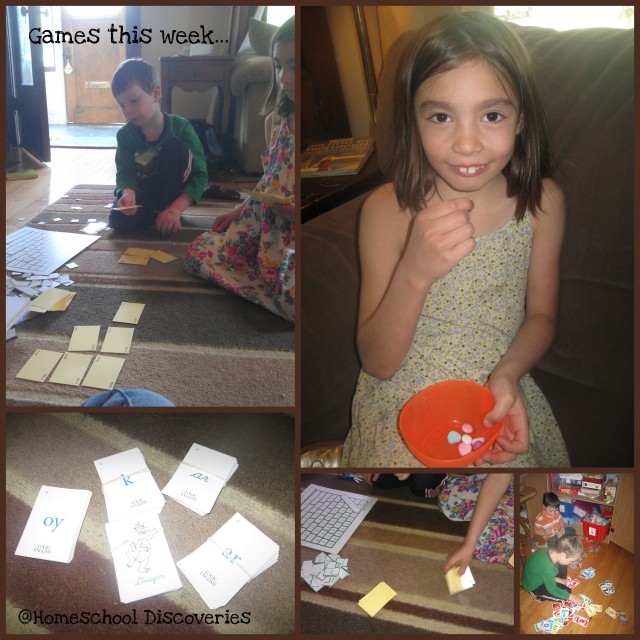
Besides the testing all morning on Monday and Tuesday, a big focus of our week school-wise was playing games:

We played games for quite a while on both Wednesday and Thursday (and maybe we’ll do that today too — we’ll see how things go!).  The highlight of our game playing for the kids probably a game I created that they named “Phonogram Treats.”   I showed the kids Logic of English (LOE) phonogram flashcards, and they got a piece of candy for saying all the sounds of the given phonogram correctly.  We cheered on the three-year-old, Mr. K, for saying anything remotely close to a correct sound or letter name and made sure that with enough hints, he ended the game with plenty of candy in his bowl too. We also played a Logic of English game called Dragon from the LOE games book. Mr. E chose not to play with us and Miss M and we found this game was not quite so fun with only two players — but at least it was good practice.

Miss M requested fraction games from the RightStart games book for our math game time.  She decided after taking the Iowa test that she had “forgotten everything she knew about fractions”.  🙂  A quick review of the RS fraction chart brought it all back to mind, and we enjoyed “Fraction War” and “One”.  Mr E played “One” with us (making rows of fraction cards to equal one), and it was impressive how well he was understanding fractions after just a short introduction to the subject and playing the game with us.  Joan Cotter is so right — even Kindergarteners can understand fractions by playing games!

The boys continued the game playing theme on their own by dumping out a variety of card games, and playing a few by their very own rules, including a messy, crazy version of Uno.  🙂

Here are a few other highlights from our week:

1. and 2.  We kept things light and fun on Monday and Tuesday after testing.  We celebrated completing the day of testing on Monday with our first water gun fight of the year.  We celebrated completing the test as a whole on Tuesday with Miss M’s choice of lunch — her favorite take-n-bake pizza and watermelon (our first watermelon of the spring/summer as well!)

3. The boys enjoying their library books

4. The kids decided to hold a “funniest costume contest.”   After I refused to pick a winner, they demanded I put the picture on FB to have my friends vote.  After not-quite 24 hours of voting, I think Mr. K (the pirate-cheerleader-granny as one friend called his costume) will be the highest vote-getter.  Many friends declared it a three way tie and also refused to vote.  😉

5.  Artwork created by Miss M and Mr. E.   Mr. E drew the toucan-like bird in the upper center of the picture.  His drawing skills have taken a massive leap forward in recent weeks!  I continue to think I don’t really need to teach these kids how to do art or drawing…they are so creative and talented all on their own!

6. Another week, another trip to Ikea to meet an out-of-town friend.  Seriously, we had not been to Ikea for months, and now we’ve been twice in two weeks! This time we met a college friend of mine visiting from Colorado.  The kids enjoyed afternoon treats and a movie in the kids area while my friend and I chatted!

7. Our flight unit study continues.  This week read read about Charles Lindbergh (book not pictured) and Louis Berliot.  I found a PBS/NOVA video about Berliot at the library that we all enjoyed watching together.  Miss M completed a few more lapbook pieces as well.

Later this afternoon we leave for a weekend trip to visit my husband’s family in Iowa and hopefully catch up with a few friends as well.  As much as I would like to get a bit more school-ish stuff done today, I have a suspicion that today will be mostly consumed with errands and packing as we get ready to go.  It never seems like it should take very long to just pack for a two day, two night trip…but somehow it always does!

Have a wonderful weekend!

I’m linking up with Collage Friday @ Homegrown Learners and the Weekly-Wrap Up @ Weird Unsocialized Homeschoolers.

PhotobucketWeird Unsocialized Homeschoolers


Book Discoveries this Week: Phantom Tollbooth and Baby Island May 17, 2012

Filed under: Books — kirstenjoyhill @ 11:29 pm
Tags:

I’m going to share about my two most recent bedtime read-alouds with Miss M for this week’s Read-Aloud Thursday, since only one of them was fully a read-aloud.   Miss M and I read part of Baby Island together (maybe about half), but I “caved” and let her take the book to read much of it on her own.

Phantom Tollbooth by Norton Juster is a language-lover’s delight.  Milo,  a rather bored-with-life boy, finds that a tollbooth has mysteriously appeared in his bedroom.  There’s nothing to do but get in his toy car and drive through the tollbooth’s gate and see what happens next.  Milo finds himself transported to a strange land with characters like Tock (a watchdog with a giant clock for a body), the whether man, the not-so-wicked-which, the Humbug, and police officer Short Shrift.  Milo’s quest is to complete the seemingly impossible task to rescue twin princesses Rhyme and Reason and return them to their kingdom (where their presence has been sorely missed, due to the lack of their namesake qualities while they have been missing).

I love puns and other types of word play. I would seriously consider putting up signs like this.   Phantom Tollboth is full of verbal humor. I was a little bit worried early on in the book that Miss M would miss a lot of the humor by not being able to see how various names in the book are spelled as I read aloud to her.  I showed her some of the names and explained a few jokes, but I found she was enjoying the book and finding it funny even without me doing this very often.

Quite often I heard Miss M repeating one of her favorite quotes from the book.  At one point, officer Short Shrift throws Milo and Tock in jail with a sentence of six million years.  However, after a few hours hearing the sad story of their jail-cell-mate (the not-so-wicked-which), they discover they can press a button and leave any time they wish.  The which tells them, “Oh, he likes throwing people in jail but he doesn’t care about keeping them there.”

We both enjoyed this book quite a bit.  I guess the most hearty recommendation comes from Miss M who spontaneously exclaimed at the end of the book, “That was one of the best books I’ve ever read!”

After finishing Phantom Tollboth, we started in on Baby Island by Carol Ryrie Brink.  We read and enjoyed Caddie Woodlawn (also by Carol Ryrie Brink) earlier this year, and I was interested in giving another of her books a try.  I saw this title on one of the many book lists I have been browsing lately, and requested it from the library.

In Baby Island, Mary and Jean are traveling on a ocean liner alone, heading to meet up with their father in Australia.   They love babies and toddlers, so when the ship seems about to sink, their first thought is of the small children they have befriended.  Through a series of miscommunications and mishaps, they end up alone in a lifeboat with four small children, ages 4 months to 2 years.   They soon reach an island they dub “Baby Island” and begin the task of raising these four babies.

I found Baby Island to be a light read, and not one that seems to have faired well against the test of time.  There seemed to be a lot of dated expressions and concepts that were perhaps common at the time the book was written, or in the recent past.  But it seems puzzling today why anyone would think, for example, that “bananas before breakfast are bad for the digestion.”

This story was easily at Miss M’s reading level, and I wasn’t quite as enamored with the story as she was, so when she begged to continue reading the book on her own one night after our read-aloud time was done, I gave in and let her (usually I say “no” because I really want to share our read-aloud’s together!).   This is truly a story for children (probably girls in particular) — Especially those who are enamored with babies and delight in the fantasy of living on a desert island with some cute kids to take care of.

I, on the other hand, could sympathize more with how the parents must have felt being separated from their young children for so long (In the book, 12 year old Mary hopes the mom of three of the four kids is enjoying a nice vacation!), and kept pondering how the 4-month-old could possibly thrive on canned mild and goats milk.   Of course, no mention is made of having to wash out dirty cloth diapers!

This story doesn’t have the universal appeal to all ages that many of our read-alouds have, but it was a fun story for Miss M to enjoy much of on her own.

I’m linking up with Read Aloud Thursday at Hope is the Word!


M is for Minneapolis and May Day

Filed under: Fun Stuff and Extras — kirstenjoyhill @ 7:26 am

I had so many ideas for blog posts starting with M — Messes, Math, Music, Museums…

But I decided to go for something a bit more unique to us — My city Minneapolis, Minnesota and a unique celebration in our neighborhood for May Day.

Despite the drawback of cold, snowy winters, Minneapolis is a beautiful and fun city to live in, and a city with so many great resources for homeschoolers:

  • We love the many, many beautiful parks, lakes and trails in the city.  Almost every park has a free wading pool! Many of the parks offer reasonably priced sports programs and other activities.  Miss M even did pottery classes at our neighborhood park last year!
  • So many wonderful museums, historical sites and other attractions in Minneapolis and in the larger Twin Cities (aka Minneapolis, St. Paul plus their suburbs) metro area.
  • Our huge downtown library with many neighborhood branches, plus the resources of the entire county library system.
  • Enough homeschool groups, co-ops, classes and activities that you can really say there is “something for everyone” somewhere in the Twin Cities metro area.  (I guess this can be a drawback in some ways as well — one family can never do everything, so I sometimes feel bummed that we can’t do many of the neat things I hear about! We are in a stage of life where it’s difficult to do too many organized classes and field trips…something that will change I am sure as the kids get older!  With so many options even just for choosing a co-op, there’s the potential to spend hours doing research to find which one is “best”).
  • Opportunities to be exposed to lots of cultural diversity.  I’m sure this isn’t unique to Minneapolis, but I like the fact that my kids are playing at the park right along side kids speaking Spanish and kids from Somali families that may dress differently than we do…but they are all kids, just playing together at the park.   If anything, I wish we had more opportunities to not just see a variety of people around us from various countries, cultures and races, but to really interact and get to know them (since in reality, most of the people we spend time with regularly still look a lot like us!).

Within Minneapolis, we live in a neighborhood called Powderhorn Park (named after, yes, the park in our neighborhood!).  It’s a fun, quirky and diverse area.  We have a really unique neighborhood celebration called May Day.  It’s usually on the first Sunday of May.  This year, it got rained out and had to be postponed to the next weekend (which was this past Sunday, on Mother’s Day).

The May Day festival brings out tens of thousands of people from the neighborhood, the city, and well beyond.  There’s a parade like nothing I’ve ever seen anywhere else, and a festival in the park that includes some of the “normal” stuff like food vendors and music…and also a pageant of sorts that celebrates the arrival of spring in a way that is, well, pretty pagan (with elements of things like bowing down to the sun).

The pageant is a bit much for us, but the pagan element of things in the parade is a bit more subtle. We feel like we can enjoy the beauty of the artwork in the parade, appreciate the diversity of cultures, opinions and world views represented, and use it as a good opportunity to teach our kids how to respect and appreciate all they see around them in our neighborhood while still viewing it through the lens of our Christian worldview.

It’s so far from the typical parade you almost have to see it to “get it.”   The only motorized vehicle in the parade is the obligatory police car at the beginning.  Everything else is human/bicycle powered! The parade always tells a story in a few “acts.”   Usually the story has something to do with protecting the earth, conserving resources, the evils of hyper-consumerism, and sometimes a jab or two at big business.   There are always a number of fun musical groups — rag tag “marching bands” of local residents of all ages, a calypso band, and a couple groups of traditional Aztec drummers and dancers.   The parade ends with a “free speech” section where anybody or any group can march to promote or protest anything they please.   This year we left before much of that section came through.  It can get a little crazy!

Our kids love the crazy and beautiful costumes and the fun music.  As they are getting older, it spurs all kinds of interesting questions and discussion (both the parade itself and the people gathered to watch it).  Miss M asked why a particular group of people was dressed all in black.  My flippant response was “oh, because they think it’s cool to do that.”   Tony had a more thoughtful response, something along the lines of how people often feel they have to dress a certain way to fit in, and many people who choose to wear all black may do so because they feel like they don’t fit in or have been hurt by the culture around them.

I’m glad he had such a thoughtful response, because I want my kids growing up thinking in a caring way about all the kinds of people they see around them, and how they might be able to show them the love of Jesus.

To see what other bloggers are writing about for the letter M, visit this week’s Blogging through the Alphabet @ Ben and Me!

Photobucket