Homeschool Discoveries

Sharing a few things I've discovered along the way…

100 Days and Leap Day February 22, 2012

Filed under: Holidays — kirstenjoyhill @ 10:40 pm
Tags: ,

I started the school year with great intentions of tracking exactly how many “school days” we had completed so that we too could have one of those cool “100th day” celebrations I had heard about.  Our state does not require a particular number of school days nor are we required to track or report “attendance” in our homeschool, so it was purely my own motivation driving me.  Obviously it was not a large amount of motivation, because my cute checklist fell out of use around day 20!

I had my planner out today to count how many weeks we had left before we take a summer break (we’ll do some school over the summer, but a much lighter load), and how this corresponded to the number of lessons we have left in RightStart Math level C.  (I think we’ll have somewhere between 10 and 20 lessons left in the level by the end of May).

On a whim, I decided to look at the calendar and attempt to count how many days of school we have completed.  While I am not 100% sure of my accuracy, I think today actually marked our 100th day.  Whoops!

Not being one to want to miss out on a celebration, I think we’ll have a slightly belated “100th day” celebration next week and celebrate “Leap Day” (aka February 29th) as well.

There are so many ways to celebrate 100 days — many of them involving math of course!  Here’s one link I liked with many, many ideas!

I also created a board on pinterest with some of the links and ideas I have found so far for celebrating both 100 days and Leap Day.

Do you celebrate 100 days of your homeschool year? Are you going to do anything special for Leap Day next week?

{photo credit}


Tech Tuesday: Finding Great Educational Apps February 21, 2012

Filed under: Technology — kirstenjoyhill @ 10:09 pm
Tags: , ,

When we got our iPad last fall, it didn’t take me long to realize that finding good educational apps in the app store can be a frustrating experience.  I felt like I was wasting a lot of precious time sorting through page after page of apps, while finding few that would meet our needs.

I feel very fortunate to have discovered a great site — Apps for Homeschooling.  Site owner Jennifer has reviewed dozens of apps, maintains a page of free and sale price apps that is updated regularly, and regularly does give-aways or “tosses” for promo codes that can be used to get free apps.   This is really not just a site for homeschoolers — anyone looking for educational apps for their kids will find this site useful.

If you like Apps for Homeschooling on Facebook, you’ll see almost-daily alerts to these free and on-sale apps, as well as having the opportunity to jump in on promo-code “tosses”.  Even when you do find apps you like for your iPad, iPhone or iPod, it’s easy to be tempted to spend way too much money buying them all.  🙂   By checking the Apps for Homeschooling site or reading Jennifer’s posts on Facebook, I have gotten many, many apps for free or for a very low price.

Another site I recommend is Digital Kindergarten, a blog written by a Kindergarten teacher who uses iPads in her classroom.  Check out the two pages she mentions in this post for a long list of apps she finds useful.

I also take note when bloggers I already enjoy share about their favorite apps Carisa at 1+1+1=1 and Erica at Confessions of a Homeschooler both share lists of apps they like.

As I mentioned in my first Tech Tuesday post, I have a Pinterest board dedicated to homeschool tech, including several links to posts or sites with lists of educational apps.  I’ll keep adding more as I find them!

What sites have you found to help you discover great apps?

I’m linking up with Tech Tuesday @ Sunflower Schoolhouse!


How We Picked a Math Curriculum — Part 1

Filed under: Curriculum — kirstenjoyhill @ 7:07 am
Tags: ,

When Miss M was about four and a half, I decided I wanted some of kind of curriculum to guide me as she progressed beyond simple counting.  I knew I wanted a program that would keep things fun, and would involve little to no handwriting, since at that time, Miss M struggled to write any numbers at all.  A friend had a copy of Saxon Math K that I was able to take a look at. I saw that this program involved no writing, and had scripted lessons for the parent to follow.  I soon found a used copy, bought a few inexpensive manipulatives, and began progressing through the lessons with Miss M.

The lessons in Saxon Math K are fun, and (in my non-professional opinion), age-appropriate for an older preschooler or younger kindergartener.  We started working on a calendar, we used plastic bears to count, add and make patterns and we reviewed shapes.  But something quickly became clear to me — the way Saxon Math K jumped around from topic to topic drove me crazy!  We would spend a day working on counting, only to have the next lesson focused on shapes, followed by a third lesson on a topic altogether different before returning to a lesson on counting.   I tried to make my own plan for re-arranging the lessons in a way that would involve less jumping around, but it was a lot of work to do so.   After using Saxon for a couple months, I knew that when Miss M started her Kindergarten year I needed to have something else.

As I researched math curricula, I learned that math programs generally either follow a “spiral” philosophy or a “mastery” philosophy.  Some may be more extreme than others in the degree to which they follow these philosophies.   Programs that lean toward the spiral philosophy introduce several topics, then “spiral” back to the first, second and so on to give the student greater depth and more exposure, then the cycle repeats.  Spiral programs have lots of built in review, and keep students from getting bored by varying the topics studied.  Some students, however, may be frustrated by only getting a taste of a topic and not having time to develop a skill before moving on to another topic.

The mastery philosophy is just what it sounds like — mastering one topic before moving on to the next.   Curricula that follow the mastery philosophy will also tend to pursue a topic to greater depth before pursuing a new topic.  For example, instead of moving on to single digit subtraction after single digit addition is mastered, a mastery curriculum is more likely to continue to two, three and four digit addition before introducing subtraction.  At the extreme a mastery curriculum may have the student studying the same general topic like addition or subtraction for an entire level of the curriculum.  Common criticisms of mastery curricula are boredom and lack of review.  Students may get burnt out studying subtraction for months on end, and may forget some of their adding skills in the mean time.

Having learned about these approaches to math education, I knew I would prefer a curriculum that leaned toward the mastery approach.  I didn’t think I would like something on the extreme end of the mastery spectrum, but in general the mastery philosophy made more sense to me.

Having ditched Saxon Math K not long before Miss M was beginning her actual Kindergarten year, I wasn’t quite ready to commit to a particular curriculum that I might be using for years.  As a stop-gap measure, I decided to begin K with Kindermath by Eagles Wings, a program I had recently received along with a phonics and spelling package I had purchased.

Kindermath is nice simple program for Kindergarten students.  It doesn’t have any bells and whistles — just a simple teacher manual and student workbook, both in black and white.  But, this gave me something I could do with Miss M for math.  We used it for the first four months of her K year.  After that, we began RightStart — the program we are still using!  I’ll discuss why we chose Right Start and how it works for our family in part 2 (Now posted — read it here!).

If you are looking for more information on how to chose a math curriculum, this article is a great starting point.  I also highly recommend checking out the wealth of resources (including articles and product reviews) at homeschoolmath.net!

What resources have you found helpful in the process of picking a math curriculum?


(photo credit)


Collage Friday: Valentines Fun and New Stuff February 17, 2012

Filed under: Weekly Highlights — kirstenjoyhill @ 2:42 pm
Tags: , , ,

Our week had a bit of a different rhythm than usual with a fun day of “Valentines School” on Tuesday.  Here’s a snapshot of our week:

1. I had so much to say about Valentines day that it got its own post with a full recounting of our activities.

2. Grandma Karen dropped by for a couple hours on Wednesday.  Aren’t all the kids cute cuddled up with her in the big chair while she reads?

3. Miss M got a “Sand Art” craft kit from Grandma Karen as a Valentines gift.  Here she is working on it at her desk in her room.

4. The geometry lessons in RightStart Math C proved a bit more challenging this week.  At one point neither of us could figure out how to divide a circle into thirds.  This happened in the late afternoon one day (we had procrastinated finishing the math lesson).  When I was more awake the next day I remembered how to do it and could help Miss M!  Using the drawing tools to make a clock also proved a bit challenging.  I thought I was giving Miss M the proper directions, but the first result was a clock with 12 numbers ending about where the seven should have been.  Whoops! I had to make one myself before I could explain to Miss M how to do it properly.  The drawing lesson directions clearly assume a bit more spacial reasoning than I seem to have!

5. We finished Mystery of History vol. 2 this week and started in with the first two lessons of Mystery of History Volume 3.  I love the full color pictures!

6. I also gave Miss M a new book for writing practice — Spectrum Writing Grade 2.   While I wouldn’t say that this basic workbook is an excellent method for teaching writing, I am in the “something is better than nothing” mode with this.  Since I was ordering Mystery of History Vol 3 from the Hearts at Home curriculum store anyway, I picked up this book on sale as well.  Miss M told me she really likes her new writing workbook, so that is a good sign, I suppose.

7. Miss M practiced counting by sixes and sevens this week.  When Mr. E saw the bugs on this sheet from Miss M’s math book, he wanted to know if he could learn how to “count by sixes all the way to nine.”  That led to a great discussion about what it means to “count by” something, and he practiced counting by 2’s!

8. Late night Lego play with daddy — he let the boys stay up an hour past their bedtime to make some really fun Lego creations together.

9. Just for fun — gotta love the Nutella “beard” on Mr. K!

Now TGIF!…(part of our day today involved all three kids taking a turn at spilling all the cards to a certain game in which the cards need to be sorted in a particular way…and the cards were spilled on purpose each time.  Sigh!)  We’ll have a definite three day weekend from school since daddy is off from work on Monday.  Tuesday baby J has a medical appointment and circumstances are such that we might not get much school done that day either.  A mini-break will be nice!

Linking up with Collage Friday @ Homegrown Learners and Weekly-Wrap-Up @ Weird, Unsocialized Homeschoolers! 


Valentines 2012 Wrap-Up February 16, 2012

Filed under: Holidays — kirstenjoyhill @ 11:08 pm
Tags:

We had a whole day of fun and “Valentines School” for Valentines Day this year…and we didn’t even get to everything that I had in mind! Here’s some of what we did:

Some years I have made a special breakfast for Valentine’s, but this year I just made a dish that is a favorite with my kids — baked apple french toast.  We started our day of “Valentines School” with fun printables.  Everyone enjoyed the Valentines Early Learning Printables from Homeschool Creations.  I also printed a couple of Valentine’s word searches for Miss M.

After everyone was bored of working at the table, we read a stack of books related to love or Valentines.  Most were selected by the kids during last week’s library trip.  I selected the classic “Guess How Much I love You” from our bookshelf.  None of the books the kids picked out were particularly classics, though “Zombie in Love” did get several readings this week at our house! I also re-read with Miss M the chapter from Mystery of History II on the true origins of Valentines Day.

Following the theme of love, we read 1st Corinthians 13, the traditional “love chapter” in the Bible.  I printed out the key words from the “love verses” and had the kids put the verses into categories of what love is or is not and we discussed those qualities of love.  The kids were very excited to decorate the poster when they were done.

Heart shaped food is great for Valentines of course, so I made the kids heart-shaped grilled cheese and I attempted to draw hearts in their tomato soup using whipping cream and a tooth pick.  The kids laughed at me in a good-natured way and said they didn’t look like hearts, but I think they appreciated the effort.  🙂

After lunch it was time for candy math! Using inspiration and printables from several sites (here, here, here, here and here) we tore into a bag of conversation hearts and went to work.  Miss M and Mr E both most enjoyed making a graph of the colors of candy hearts in each of their bowls, while Mr. K’s favorite activity was making patterns.

Miss M took some time to finish a “Heart Tree” craft kit she started last year at Valentines, but never finished.  It’s now decorating our buffet!  After that, she finished addressing envelopes to mail a few valentines.  Yes, our recipients got them a little belatedly since they went in the mail on valentines! This was Miss M’s first time addressing envelopes on her own, and it was a good practical lesson on our fun “valentines school” day!

We went out to drop off a few valentines at neighbor’s houses and take our larger envelopes to the post office.  Upon returning, we opened valentines mail and gifts we received!

We rounded out our special day with heart shaped pizza, homemade white chocolate pudding with strawberries and special drinks that daddy brought home.

It was a fun and full day…no wonder I was exhausted at the end of it.  🙂

I’m linking up with Love-ly-ideas at Homegrown Learners! I’ll be looking forward to reading what other bloggers have posted and bookmarking or pinning ideas for next year!


Book Discoveries this Week: The Borrowers

Filed under: Books — kirstenjoyhill @ 1:15 pm
Tags:

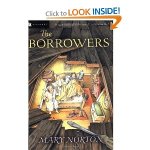
When I selected “The Borrowers” by Mary Norton as a bedtime read-aloud with Miss M, I had no idea that I was actually making a timely choice of sorts.  I added it to my list of potential read-alouds at the beginning of the year. We picked it up at the library a couple weeks ago because I didn’t have any other read-alouds on our own shelves I was excited about that day, and I hadn’t planned ahead and requested or ordered anything else.  The Borrowers happened to be on the shelf at the library.

Miss M and I were then very surprised over the weekend to see a preview for a movie based on The Borrowers called “The Secret World of Arrietty” opens in theaters tomorrow (February 17th)!

Back to the book — “The Borrowers” is the story of a family of very tiny people (only a few inches tall) that live under the kitchen of an English country house.  Homily, Pod, and their teenage daughter Arrietty are the only remaining Borrowers in a house that once supported many.  Although her parents (like all Borrowers before them) go to great lengths to not be seen by “human beans” as they call them, Arrietty is willing to break the status quo to befriend a human boy.

I had mixed feelings about the book.  I have vague memories of reading this as a child and it is a fun and exciting story.  On the other hand, I had a sense of dread on behalf of the characters as I read the book, knowing the fate that befalls them at the end of the book (both just from an educated guess as to the plot arc and also from reading the description on the back of the sequel!).   It’s nothing too awful (small spoiler here) — they end up being forced to leave their home — but I did feel bad for them knowing what was going to happen.

I was also able to put some new knowledge from “Uncovering The Logic of English” to work.   The word “draught” has always puzzled me though, I must confess, not enough to have looked it up in the dictionary (I know, terrible for a homeschool mom and a former English major).  I thought it rhymed with “taught” and I really couldn’t quite figure out what it had to do with beer (this being the context in which I had seen it).  In “Uncovering the Logic of English,”  the word “draught” is used as an example of another word like “laugh” where -augh makes an “af” sound with a short “a”.   All of a sudden, the word “draught” makes so much more sense as the British spelling of the American English word “draft” — a word used for beer and for a breeze across a room (the context in which it is used in “The Borrowers”.

Miss M enjoyed The Borrowers quite a bit — enough to pick up the first sequel and start reading it as soon as we finished the original as a read aloud (we already had this book, “The Borrowers Afield” on our shelves from a library book sale last year). She’s also very eager to see the Arrietty movie as well.   We don’t go to many theater movies, but perhaps we’ll make our way to this one.  While I am sure they took artistic liberty with the story, it has to be better than the movie adaption of Mr. Popper’s Penguins, which had almost nothing to do with the original book (and much to my dismay, Miss M liked the movie version better!).

I’m linking up with Read-Aloud Thursday @ Hope is the Word!


Resources for Learning the US States

Filed under: Books,Technology — kirstenjoyhill @ 8:18 am
Tags: , ,

Miss M is in the middle of her first big memory work project right now — learning the names and locations of all 50 states in the USA.  Our homeschool co-op does a geography challenge each year in May, and this is the challenge for students in second grade.  Miss M wanted plenty of time to prepare, so we started this in January.

The starting point for Miss M’s memorization efforts has been “The Little Man in the Map” by E. Andrew Martonyi.  Little Man in the Map gives readers memory clues in rhyme to remember the shape of each state.  It’s really quite clever.  The “little man” is made from the line of states from Minnesota down to Louisiana (Minnesota is the hat, Louisiana is the boot…can you see what the states in between might be?).   The “little man” comes to life and provides other clues — such as Tennessee and North Carolina being a table, with the four states beneath as legs.  So far this has been a really helpful method for Miss M to remember each state, and she has memorized more than half so far!

We’re reinforcing this learning with lots of fun games on the iPad and computer:

On the iPad, Miss M’s favorite app for state practice is Wood Puzzle.  Wood Puzzle has a practice mode and a quiz mode and involves dragging states to the right spot on the map.  It also has a mode for state Capitals.

We also have iTeachStates and TopoUSA.   Iteachstates has a few different modes, including dragging the states to the correct position and a multiple choice quiz.  TopoUSA involves helping a little plane fly to the correct state.

There are many other state geography games and learning apps available in the App Store.  One I’ve heard several friends say they like is “Stack the States”.  To be honest, I’ve been waiting to see if the full version would ever be available for free (I got the other state apps for free by downloading them on a day when they happened to be available with no charge).  Perhaps some day soon if it doesn’t go on sale I’ll drop the 99 cents for it so Miss M can try it.  🙂

Our site of choice for practicing states on the computer is the USA Geography section of Shepherd Software, a site with many free educational games for kids.  This site has practice games for learning states, capitals, and other geographical features such as lakes.  Games are available at several levels of difficulty.

If you are looking to practice with traditional paper maps, check out the free printable maps for the USA (and the rest of the world) at Education Place.

We may also consider purchasing a board game or two for additional practice.  I have 10 Days in the USA and Scrambled States on my Amazon wish list.

Do you have any favorite resources for learning the US States?

I’m linking up with this week’s Tech Tuesday @ Sunflower Schoolhouse!


Collage “Friday” (on a Saturday): A Birthday and other Fun February 11, 2012

Filed under: Weekly Highlights — kirstenjoyhill @ 5:26 pm

Here’s a little bit about what we’ve been up to this week:

1. & 2.  Happy 3rd Birthday to Mr. K!  His birthday was on Monday, and we had a small party on Sunday afternoon. Our family tradition is to let the birthday boy/girl pick the menu for the day and a fun activity on the day of his/her birthday.  Mr. K picked donuts for breakfast, Cars soup for lunch, Cars Mac and Cheese and chicken for dinner, and bowling as his fun activity.

3.  We had a Valentine’s party at co-op this week. Miss M wanted to make her own valentines this year for her co-op class, but wasn’t sure what she wanted to make.  It was the perfect use of pinterest! I showed her a number of links I had pinned to homemade valentines, and she picked the one she liked best.  I printed out the template, and she took it from there!

4. I haven’t had much patience lately to let the kids help me in the kitchen, but this week I let them help me with the dumplings for our chicken and dumplings in the crock pot.  Miss M made most of the dough balls, but the boys helped a bit too.

5. We scrubbed off the old exersaucer and brought it out for baby J this week…he seems to like it a lot.  It’s nice to have one more way to keep him occupied while we are doing school or I am cooking.  He’s getting more interested in trying to play with his toys every day!

6. Mr. K got some new play-doh this week.  I really, really hate the smell of play-doh (yet, somehow I never quite get around to making my own).  After Miss M was finished playing, I let the boys continue mostly unsupervised with the play-doh, since they were quiet and not fighting.  The result — one entire container of play-doh cut up into tiny chunks and spread out over the table and floor.  Sigh.  At least it swept up pretty easily.

7.  We got out the Right Start fraction chart for the first time this week.  The lesson called for folding and cutting strips of paper, but I am glad I remembered I had this instead!  We only made it through three lessons this week, having gotten bogged down in the warm-ups on two different days.  The geometry/fractions portions of the lessons were only mildly challenging for Miss M, but we discovered a particular subtraction strategy that had been forgotten, and some of the multiplication proved more challenging for Miss M than I had expected.  It was good to slow down both for the purpose of review and reinforcement, but also to deal with the character issues this brought up.  Miss M was not happy to hear that she had given me the wrong answers on these warm-ups.   We took the time necessary to deal with the heart issues.  While I don’t “love” these moments as the occur, I love these opportunities homeschooling brings us to work on Christ-like character (for mom and children alike!).

8.  Arts and crafts completed by Miss M and Mr E this week.  While sometimes I think to myself that we should be using some of the art curriculum materials I purchased for this year…other days I look at the projects my kids complete of their own volition, and remember that they have many, many good art/craft experiences with very little involvement from me at all!

9. We had a very short morning of school on Friday, leaving most of the rest of the day for fun.  We enjoyed a gym playdate, hair cuts for Miss M and Mr. E, and a trip to Half-Price Books.  I brought a huge box of books in to sell (mostly some pretty junky books that were really dead weight on our bookshelf), and of course still spent well beyond the credit I received for the books I brought.  🙂  Each of the kids got to pick out some books for themselves, and I found a few titles I was looking for.   After our outings, the kids packed their bags and went to Grandma and Grandpa’s house for the night so mom and dad (and baby) could go out for a fancy early valentines date and then our church’s annual marriage retreat.  What a fun Friday!

I’m linking up with Collage Friday @ Homegrown Learners and the Weekly Wrap-Up @ Werid, Unsocialized Homeschoolers!

Photobucket


Book Discoveries this Week: Joan of Arc February 9, 2012

Filed under: Books — kirstenjoyhill @ 10:25 pm
Tags: ,

I’m finding it hard to believe that we are almost done with our journey through the Middle Ages.  We only have three lessons left in Mystery of History Volume II (if last week and this week would have gone as planned, we would already be finished!), and MOH Volume III arrived yesterday.

I think we’ll still have a few read-alouds yet this year that take us back to the Middle Ages — I just keep finding more books I’d love to read related to this time period.

Our history read-aloud this past week was Joan of Arc by Diane Stanley.  Both Mr. E and Miss M enjoyed this in-depth story with beautiful illustrations.  (Mr K on the other hand had to be “bribed” with the iPad in order to keep him quiet enough for us to finish this book.  He tried very hard to convince me not to continue reading it!).

Having read a somewhat extensive lesson about Joan of Arc in our Mystery of History book, I wasn’t sure  if Miss M would want to devote even more time to learning about Joan.   I gave Miss M the choice as to whether or not we would read this book, and she was pretty eager to read it.  She was fascinated by the idea of a woman fighting for her country back then.  Stanley’s story of Joan of Arc provided additional details that were not in our history lesson and made this famous story seem even more amazing.  I would have to say, though, that the illustrations were my favorite part.  The are done in a style somewhat reminiscent of an illuminated manuscript and are very bright and colorful.

In recent weeks we also read Ms. Frizzle’s Adventures: Medieval Castle by Joanna Cole and The Chanticleer and The Fox by Barbara Cooney as quick history-related read alouds.  Ms. Frizzle’s castle adventure was about what you would expect — a fun, silly story with some real facts thrown in here and there.  The Chanticleer and the Fox was a bit of a disappointment to me.  When I requested this one from the library I was envisioning a picture book with poetic text, but Cooney’s book is more of a retelling of Chaucer’s story in non-poetic form.

Tangentially related to our history studies is a book the boys loved this past week: A Good Knight’s Rest by Shelley Moore Thomas.   In this story, the Good Knight (who is featured in several books by Thomas) needs to take a restful vacation, but his pals the little dragons make that a challenge.  I like the “Good Knight”/”Good Night” pun (and don’t quickly tire of it), so that makes these books bring a smile to my face.  🙂

And finally, not at all related to the Middle Ages, is the boys’ other favorite book this week: The Donut Chef by Bob Staake.  The Donut Chef is a story in rhyme about a chef who opens a donut shop, only to be challenged by a competing shop that opens next door.  The two shops try to out-do one another:

“We’ve donuts laced with kiwi jam and served inside an open clam! Donuts made with huckleberry (Don’t be scared, they’re kind of hairy).  And donuts made from spiced rum pears, so popular with millionaires!”

It’s hard not to smile at rhymes like that.  After trying many, many flavors and shapes, the donut chef finds out what the most popular kind of donut really is.

What books did you discover this week?

I’m linking up with Read Aloud Thursday @ Hope is the Word!


“Uncovering the Logic of English” by Denise Eide February 8, 2012

Filed under: Books — kirstenjoyhill @ 6:09 pm
Tags: ,

When I think back to elementary school, the subject I disliked most was spelling (and it’s probably the subject I struggled with the most as well).  I remember spending what seems like hours drilling weekly spelling words with my mom’s help, only to still get mediocre grades on spelling tests and still spell words wrong on papers in later grades when spelling tests were only a memory.  The only thing that really helped my spelling was starting to use spell check on a regular basis as a high school student.  I was an editor of my high school newspaper, and after seeing certain words with the familiar red underlining many times over while typing up stories, I finally memorized the correct spelling.  I went on to get a degree in English and I now even do some freelance editing, yet I still struggle to spell certain words.

As I began researching phonics and spelling programs a few years ago for Miss M, I made an exciting discovery: There are actually reasons why some words are pronounced or spelled the way they are.  This seemed like a much better way to learn spelling than the “memorize a random list” method I experienced in elementary school.

It didn’t take long to find out that even with an approach to spelling that included some rules, Miss M still struggles to learn spelling.  She is so much like me!  We’re on our second spelling curriculum already, and I haven’t been 100% pleased with either of the ones we’ve tried (but that is a subject for a different post!).

So, I was quite intrigued when I saw a few messages on a local homeschooling list about a book and curriculum called “The Logic of English”.   After some quick googling, I quickly decided that my first purchase with a recently-received amazon gift card would be the book “Uncovering the Logic of English” by Denise Eide.

Eide is an educator (and a homeschooling mom herself) who sets out to prove that English is not nearly as illogical as most people think it is. Eide first discusses the need for students to learn the 74 basic phonograms (one or more letters that represent a sound) of the English language (a common idea among many spelling programs that don’t rely on sheer memorization or visual patterns).  I’ve been meaning to work on this with Miss M, but have failed to put good intentions into practice.  Whoops!  There are also 33 more “advanced” phonograms in English that occur less often.

Besides the 74 basic phonograms, Eide offers 30 spelling rules that explain the spelling of most words in the English language.  Most of the rest of the book is devoted to these rules.  While most people might not consider this riveting reading, I was fascinated.

These aren’t rules like “i after e except before c”, a rule with many exceptions.  For example did you know that English words do not end in I, U, V or J? That’s rule #3.  A key thing to note in the this rule is the word “English.”  There are a few foreign words adopted by English (like “chai” and “ski”) that break this rule, as well as “three very old English words, I, you and thou.”   But the vast majority of English words follow this rule, explaining why we need to write “hedge” instead of “hej” among many other things.

This rule also gives some sense as to why words like “give” have a silent “e” at the end, yet that silent “e” does not make the other vowel say it’s long sound — “v” cannot be alone at the end of the word, so an “e” is added.

“Uncovering the Logic of English” is full of fascinating examples and rules like this.  I feel like it is unlocking a code as to why our language is the way it is.  I breezed through the book at a fairly fast rate — but I would definitely like to spend more time studying it to glean even more spelling knowledge to commit to memory.

Eide has also developed a curriculum that follows these principles — the “Logic of English Essentials” curriculum.  I’m very intrigued by it.  I think I could implement many of the principles in her book with the curriculum we are currently using (for example teaching the phonograms — our current curriculum recommends that anyway).  But, part of the reason I don’t think we are succeeding with our current curriculum is the lack of scripted lessons…or really any lesson planning at all.  “Essentials” takes care of that.  However, I’m also wondering how well Miss M could really keep the rules in mind while trying to write out words. She seems to have trouble already applying some of the rules she has learned.  But that might be lack of practice coming through as well.  I’ll need to do more research and consideration.

If you are at all curious about why words are spelled the way they are (whether you are looking for a new approach to spelling or not), I highly recommend this book!